
If your “freedom business” is starting to feel like a tiny, demanding employer who lives in your laptop and texts you at night… we need to talk.
Because what most people call burnout gets treated like a personal flaw: you’re not resilient enough, not disciplined enough, not “managing your energy,” not doing enough cold plunges, not believing hard enough in your dreams. Quick reality check: this isn’t a mindset issue. It’s a systems issue.
Burnout in freelancers and solopreneurs is often less about you “not handling it” and more about your business model quietly requiring you to be available, responsive, emotionally pleasant, and endlessly capable… forever. That’s not freedom. That’s a subscription service your nervous system never agreed to.
Let’s name what burnout actually is, how to spot it early, how to tell it apart from other issues, and what to change so your business stops feeling so heavy.
What Burnout Actually Is (And Why the Definition Matters)
The World Health Organization (WHO) defines burnout (ICD-11) as an occupational phenomenon (not a medical disease) characterized by three core dimensions:
- Exhaustion
- Mental distance / cynicism / negativity toward work
- Reduced professional efficacy (you feel less capable, even if you’re still “performing”)
This matters because it gives you a clean, credible framework without turning you into a diagnosis. You’re not broken. You’re overloaded.
Stress vs. Burnout: Here’s the Simple Difference
People confuse these constantly, so let’s make it plain:
- Stress feels like too much: urgency, over-engagement, anxiety, racing thoughts.
- Burnout feels like not enough left: shutdown, numbness, cynicism, “I can’t even.”
Stress is revved-up. Burnout is worn-down.
Burnout vs. Depression: A Necessary Safety Note
Burnout can look like depression. They can also co-occur. The difference is often scope:
- Burnout tends to center around work.
- Depression usually affects multiple areas of life (relationships, interests, sense of hope), not just your business.
If you’re experiencing persistent hopelessness, suicidal thoughts, major sleep/appetite changes, panic attacks, or you can’t function day-to-day, please reach out to a qualified mental health professional.
You don’t have to white-knuckle this.
Your Business Was Meant to Support Your Freedom, Not Run Your Nervous System
If your “freedom” business looks incredible on paper and still feels heavy, reactive, or secretly draining every single day, that’s not a boundaries problem. It’s usually because you built the thing around your time instead of your expertise, which means every dollar it makes still needs you personally in the room.
That’s the exact question Penelope was built to help you answer. She’s a free guided audit, five real questions about how you actually deliver your service, that hands you back one specific thing you could package and sell without you being personally involved in every single delivery. Not a worksheet. Not a generic framework. An actual starting point, built from your own answers.
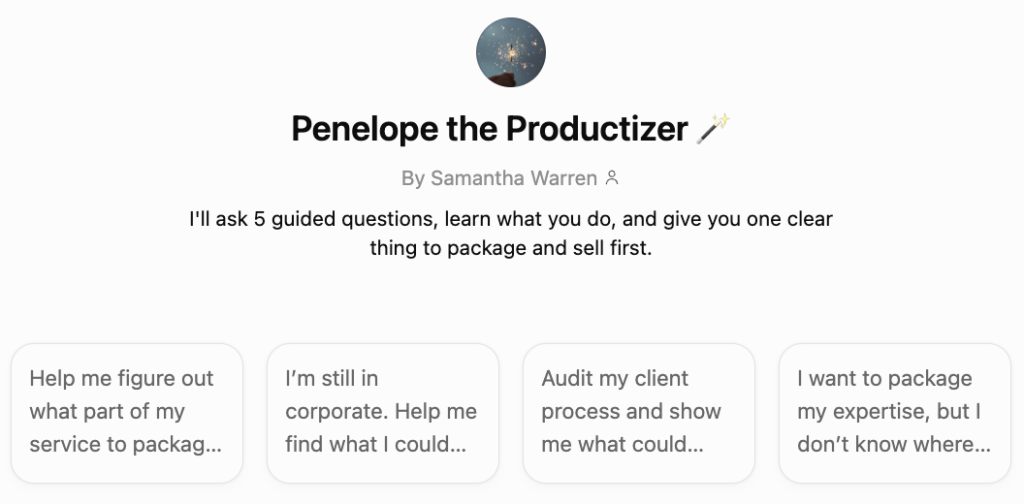
Talk to Penelope now. It’s free. Answer five real questions. Walk away with one real starting point.
Why Your “Freedom Business” Feels Heavy: The Freedom Paradox
Here’s the paradox nobody mentions in the pretty Canva carousel you saw on Insta: a business built for flexibility often creates infinite boundaries.
You’re technically “your own boss,” but:
- work can happen anytime
- clients can message anytime
- revenue often depends on responsiveness
- and there’s no built-in buffer (no HR, no coverage, no paid leave, no second-in-command)
So the heaviness you feel is usually the collision of:
- Unbounded demand
- Unbounded responsibility
- Bounded human capacity
Translation: you’re a person. Your business is acting like you’re an institution. That’s what we need to fix.
The Real Root Causes of Freelancer Burnout (Beyond “Too Much Work”)
Yes, workload matters. But most burnout isn’t just volume… it’s design. Here are the common drivers I see in service businesses.
Role Overload + Identity Fusion
When you’re the founder, the marketer, the delivery team, the admin assistant, and customer support, you’re not “multi-passionate.” You’re overextended.
And if your identity is fused with performance
“If the business fails, I fail”
rest starts to feel unsafe.
Decision Fatigue + Ambiguity Load
You don’t just do tasks. You constantly make decisions under uncertainty:
- How much should I charge?
- Will this lead convert?
- Will the client be happy?
- Did I scope this correctly?
- Will next month be okay?
Ambiguity is cognitively expensive. It drains you even when you’re “not working.”
Emotional Labor (A.K.A. Being Calm When You’re Not)
Service work often requires you to:
- stay patient
- stay pleasant
- regulate other people’s stress
- be the container
That’s emotional labor. If you don’t price and structure for it, it will quietly invoice your nervous system instead.
Capacity-Supply Mismatch (The Math Problem)
This is where things get unromantic—in a good way.
Burnout happens when:
billable work + admin + marketing + support + recovery time > actual weekly capacity
Not your ideal capacity. Your real one. The kind that includes being human and occasionally needing sunlight.
Boundary Violations Baked into the Offer
If your offer includes things like:
- unlimited revisions
- unlimited Slack/DM access
- scattered meetings across time zones
- “quick questions anytime”
- no minimum engagement size
Then burnout isn’t surprising. It’s predicted.
These aren’t personality issues. They’re product design issues.
Values Conflict (Success That Still Feels Wrong)
You can be “successful” and still be misaligned if you’re:
- selling to clients you don’t like
- marketing a persona you cannot sustain
- building a business that fights your preferred lifestyle
If you’re thriving on paper and miserable in practice, it’s not because you need more gratitude journaling. It’s because something’s off.

And if what you’re really circling is “I know I need to package something, I just don’t know what,” that’s exactly the conversation Penelope is built to have with you.
Talk to Penelope now. It’s free. Answer five real questions. Walk away with one real starting point.
Burnout Symptoms in Entrepreneurs: Early, Middle, Late Stages
Burnout isn’t a surprise attack. It usually escalates. Here’s what it can look like by stage.
Early-Stage Signs (Yellow Flags)
- needing more caffeine/sugar to start working
- irritability with small interruptions
- procrastinating important tasks (avoidance, not laziness)
- memory slips (“Why did I open this tab?”)
- lighter sleep, waking with dread
Mid-Stage Signs (Orange Flags)
- cynicism or resentment toward clients
- Sunday-night anxiety most weeks
- reduced creativity, more mistakes
- social withdrawal / canceling plans
- headaches, GI issues, tight chest, frequent colds
Late-Stage Signs (Red Flags)
- feeling numb, detached, robotic
- panic attacks or persistent anxiety
- using alcohol/weed/meds to come down or sleep
- missed deadlines, more client conflict
- fantasizing about quitting the business entirely (even if it’s “working”)
Burnout or Something Else? A Quick Differential Check
Not everything is burnout, and pretending it is can delay the right help. Consider these adjacent possibilities:
- Depression: low mood across life domains, loss of pleasure, hopelessness
- Anxiety disorders: pervasive worry, rumination, hyperarousal
- ADHD/executive dysfunction: long-term patterns since childhood; burnout can worsen symptoms
- Sleep disorders: insomnia, sleep apnea (these can mimic burnout hard)
- Medical factors: thyroid issues, anemia, vitamin deficiencies
- Compassion fatigue: common in coaching, healing, therapy-adjacent work
If symptoms are persistent, escalating, or impairing daily life, get assessed. Being “high-functioning” isn’t the same as being okay.
The Burnout Loop (Why It Keeps Getting Worse)
Here’s the cycle that makes burnout sticky:
- Overcommit
- Deliver (adrenaline carries you)
- Recover poorly (because there’s no time)
- Cognitive decline (focus drops, creativity drops)
- Mistakes increase
- Fixing mistakes takes more time
- You overcommit again to compensate
You can’t affirm your way out of this. You redesign your way out.
How to Recover From Burnout as a Freelancer: A 4-Phase Plan
This is the part where you stop collecting “self-care tips” like they’re Pokémon and actually make business changes.
Phase 1: Stabilize (7–14 days)
Goal: stop the bleeding.
- Freeze new commitments (yes, even “quick” ones)
- Reduce meeting load by 30–50%
- Pick one primary deliverable per day
- Protect a sleep window (set a nightly shutdown alarm)
- Communicate slower response times to clients
Your job in this phase is not creativity. It’s containment.
Phase 2: Reduce Load (2–6 weeks)
Goal: create slack.
- raise prices or narrow scope (ideally both, eventually)
- finish, cancel, or offboard low-value projects
- implement office hours + async communication
- hire part-time help (inbox/admin/bookkeeping) if possible
If burnout is a math problem, this is where you change the numbers.
Phase 3: Redesign (1–3 months)
Goal: prevent recurrence.
- productize services into clear packages
- build a pipeline that doesn’t require you to be always-on
- add redundancy (VA, bookkeeper, delivery support)
- build a cash buffer (aim for 1–3 months runway)
A vacation is relief. A redesign is a cure.
Phase 4: Scale Sustainably (Ongoing)
Goal: grow without heaviness.
- set max clients / max billable hours (capacity planning)
- schedule a quarterly “rest test” week (business should survive)
- track leading indicators: sleep, resentment, avoidance, recovery time
If the business collapses when you rest, it’s not a business. It’s a dependency.

Systems That Prevent Burnout (Because Willpower Is Not a Strategy)
Here are the practical levers that reduce burnout fast… not because they’re trendy, but because they reduce load.
Offer Design Fixes (Prevention-by-Design)
A burnout-proof offer has scope, boundaries, and pricing that matches reality.
Consider:
- packages instead of endless custom work
- tiered options (standard vs priority pricing)
- revision limits (with paid add-ons)
- a waitlist instead of instant availability
- async-first delivery (Loom, structured check-ins, docs)
Your offer should protect your calendar like it’s a finite resource, because it is.
Communication Policies That Protect Your Brain
You don’t need to be “low-touch.” You need to be clear.
Try:
- 24–48 business hour response window
- defined office hours (“Mon–Thu, 10–4”)
- “emergency” definition (spoiler: most things aren’t)
- designate CEO Days with no meetings
The Client Portfolio Method (Not All Revenue Is Equal)
Track each client by:
- revenue
- time cost
- emotional cost
- referral value
- growth value (skills, portfolio, network)
Then ask: who’s paying you the least to drain you the most?
Offboarding one high-drain client can feel like a nervous system upgrade.
SOPs: Replace Motivation with Process
Burnout gets worse when everything requires fresh decision-making.
Create simple SOPs for:
- onboarding
- proposals/contracts
- project kickoff
- revisions/feedback
- weekly planning
- invoicing + follow-up
SOPs reduce decision load, rework, and “Did I forget something?” anxiety.
Recovery Is a Business Asset (Not a Vibe)
You are not a machine that needs “self-care.” You are a human doing cognitive labor.
Recovery supports:
- better judgment
- better creativity
- better boundaries
- better client experience
Minimum viable recovery basics:
- sleep you protect like a meeting
- movement (walk counts)
- regular meals (your brain likes fuel)
- sunlight
- time with people who don’t need anything from you
Your Next Move…
Burnout isn’t proof you’re weak. It’s proof your business is asking for more than a single human can sustainably produce, especially when you’re also doing sales, marketing, admin, delivery, and emotional containment like it’s a fun little hobby.
Your next step isn’t a new planner. It’s a redesign:
- Stabilize (stop the bleeding)
- Reduce load (change the math)
- Redesign (fix the model)
- Scale sustainably (protect capacity like an asset)
If you want to make this ridiculously actionable, start today with one move: audit your week and identify the single biggest burnout driver (a client, an access policy, a scope issue, or too many meetings).
Fix that first. Momentum loves a clean constraint.
I love you, and always remember… you got this!!! 💙
Pin Me on Pinterest!