There’s a version of “high standards” that is actually just being a fckn control freak.
I say that with love.
A lot of the beautiful women in business do not have a laziness problem, a motivation problem, or even a strategy problem. They have a business that only works because they are constantly in it, checking it, fixing it, answering for it, and quietly carrying the whole thing on their back.
It can look impressive… but internally, it feels like being fully booked and still vaguely trapped.
I know this pattern because I built it. Before starting the Paid to Be Her movement, I scaled a marketing agency to 20+ clients by saying yes too often and staying too involved in too much.
I couldn’t go a day without checking my email & putting out any fires that happened to pop up that day.
It grew, but it also became dependent on me in a way that was not sustainable. The shift came when I stopped asking, “What else should I sell?” and started asking a better question: What part of what I already do doesn’t actually need me? That question changed everything.
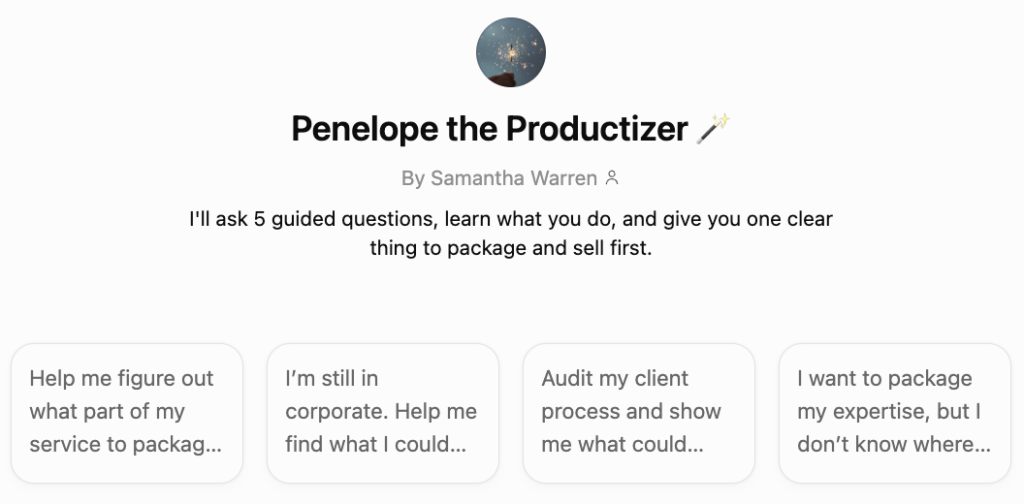
If this post hits a nerve, start there. Penelope, the Productizer is my free AI-guided audit that walks you through five real questions and helps you identify one thing in your business you could shape and package without trading more time for money. It’s not generic. It’s built for the woman whose value is real, but too fused to her personal involvement.
Why control looks responsible but behaves like a ceiling
Control is usually rewarded early.
It makes you look reliable. Detail-oriented. Client-devoted. Hard to replace, which can feel flattering until you realize you have accidentally made your business impossible to scale without your constant presence.
And for a lot of women, especially the hyper-capable ones, control is not just an operational habit. It is an identity habit.
You learned that being excellent kept things safe. Being responsive made you valuable. Being needed made you credible. So of course you built a business where your presence became the product.
The issue is that you may have confused personal involvement with actual value.
Experts often struggle to externalize what they know because much of their skill is tacit: you know more than you can easily explain. Add the curse of knowledge, and suddenly what feels “impossible to standardize” is often just something you’ve never slowed down enough to codify. That does not mean your work is too special to scale. It means your discernment has not been translated into structure yet.
Below are 10 signs this might be happening.
1. You touch every deliverable before it goes out
If nothing can leave your business without your eyes on it, you do not have quality control.
You have a dependency problem.
There is a difference between protecting standards and making yourself the final bottleneck on everything. If every client deck, proposal, onboarding email, audit, or content asset has to be “Sam-approved” energy in your business, your growth is capped at your personal review capacity.
What it’s costing you
- Slower delivery
- Team hesitancy
- Lower output
- Constant mental load
- A business that cannot breathe without you
What this usually means
Your standards likely live in your head, not in a usable system. A checklist, rubric, or definition of done would serve you better than another round of hovering.
2. You still customize too much because you think that’s what makes you good
Custom work can feel premium.
Sometimes it’s just messy.
A lot of service providers over-customize because they are still proving. Proving they’re thoughtful. Proving they care. Proving they’re worth the price. But over-customization is often where margin goes to die.
Productization does not mean becoming generic. (In fact, it’s really the opposite.) It means building a standardized backbone with a few controlled variation points.
What it’s costing you
- Scope creep
- Delivery inconsistency
- Pricing confusion
- Longer turnaround times
- Exhaustion disguised as excellence
3. You answer questions live that should already be answered by process
If clients or team members constantly need you for the same clarifications, that is not proof you’re indispensable.
It is proof you have not turned repeated decisions into assets.
Your real leverage is not only in what you do. It is in how you decide:
- what matters
- what comes first
- what qualifies
- what gets changed
- what gets left alone
What it’s costing you
- Repeated interruptions
- Decision fatigue
- Delayed projects
- Invisible emotional labor
The scalable part of your expertise is often your decision framework, not just the final deliverable.
4. You say you want freedom, but you build around reassurance
This one is subtle.
You tell yourself you want a calmer, more scalable business. But the way you operate says you want to remain the point of certainty for everyone involved.
So you keep yourself close to every conversation, every handoff, every edge case. Not because it is always necessary, but because your nervous system trusts your presence more than your systems.
As someone who has built a location-independent life since 2023 and now works from Panama, I can tell you this plainly: freedom without self-trust feels like anxiety. More freedom requires more structure, not less. You need your business to run without you.
What it’s costing you
- You can’t step away cleanly
- Travel or time off feels stressful
- You stay overly available
- Your business becomes freedom-coded, but not freedom-supportive
5. You price as if your time is the product
Hourly logic keeps your identity fused to execution.
When you price mainly around time, you reinforce the belief that your presence is what the client buys. That makes it much harder to build a business around outcomes, process, and infrastructure.
This is one reason so many brilliant women end up in businesses that look self-employed on paper but feel like private employment in practice.
What it’s costing you
- Income ceilings
- Resentment around time
- Harder delegation
- Underpaid expertise
- The belief that scaling means working more
Fixed-scope and value-aware pricing are not magic. But they do help shift the frame from me doing more to the business delivering something clear.
6. You treat every exception like a moral obligation
Not every request deserves a yes.
Not every edge case requires a meeting.
Not every client preference should become a new operating principle.
Control-heavy founders often make too many live decisions because they do not have pre-decided boundaries. Then they call the resulting exhaustion “just business.”
What it’s costing you
- Constant context switching
- Uneven client experience
- Team confusion
- Boundary erosion
- A weird amount of energy spent on things that should have been decided once
A simple exception policy can change your life:
- Included
- Paid add-on
- Not offered
7. You hire help, then make it impossible for help to actually help
You delegate the task.
You keep the judgment.
You assign the work.
You retain all the decisions.
This is one of the clearest signs of founder control: support exists, but only as an extra pair of hands, never as true capacity expansion.
Research on psychological ownership helps explain this. When you have invested time, effort, and identity into your method, it can feel like the work is you. So letting someone else carry part of it feels risky, even when it is logical.
What it’s costing you
- Frustration with team performance
- Higher management load
- Slower scaling
- Ongoing dependence on your brain
- Feeling disappointed that delegation “doesn’t work”
Often, delegation is not failing. Your systems are.
8. You keep reinventing instead of codifying
If you solve similar problems from scratch every time, you are likely overusing effort where structure would do.
A control-based business often has:
- no consistent intake criteria
- no scoring rubric
- no standard workflow
- no QA checklist
- no clear definition of done
That does not make you creative. It makes your business harder to repeat.
What it’s costing you
- Longer project timelines
- More errors
- Inconsistent outcomes
- Difficulty training others
- Less confidence in your own offer
The business shift is this: productization is not just digitizing your expertise. It is codifying your decisions.
9. You confuse being needed with being successful
This one lands.
There is a version of business growth where more people need you, message you, ask you, rely on you, and praise you for being amazing. Your ego gets fed. Your calendar gets wrecked.
At one point in my agency, I had proof of demand. What I did not have was a model that could hold that demand without consuming me. That distinction matters more than people admit.
What it’s costing you
- Your business only grows in proportion to your personal effort
- You become the ceiling
- Success feels heavy instead of expansive
- Receiving feels hard because everything depends on your constant output
You cannot receive at a level you are not being. If you are still being the rescuer, the fixer, the always-on expert, your business will keep paying you accordingly.
10. Deep down, you believe it only works because it’s you
This is the root of it.
Not the software.
Not the niche.
Not the audience.
Not the algorithm.
The belief.
It only works because it’s me.
Sometimes that belief is partially true. Your discernment is valuable. Your standards are real. Your judgment has been earned.
But even then, the next question is what matters:
What part of that can be translated into a container that still works without your full-body presence every time?
That is the entire game.
What it’s costing you
- Delayed productization
- Fear of simplifying
- Attachment to custom delivery
- Chronic overinvolvement
- A business that reflects your talent, but not yet your freedom
Your identity does not have to be the container for your expertise. Your framework can be.
What to do instead of gripping tighter
If you recognized yourself in a few of these, good. Awareness is useful when it leads to cleaner decisions.
Start here:
Separate these three things
- You
- Your skill
- Your system
They are related. They are not the same.
Build the three assets that hold your expertise
- A diagnostic: How do you assess what’s actually going on?
- A decision tree: What are the if/then rules you use?
- A QA checklist: How do you protect quality without redoing everything yourself?
Add operational constraints that make calm possible
- One request at a time
- Fixed turnaround windows
- Standardized intake
- Defined revision limits
- Written definition of done
None of that is less premium. It is what allows a business to stay open without requiring your nervous system to be on call.
Frequently Asked Questions (FAQs)
Is being detail-oriented in business the same as being a control freak?
No. Detail orientation becomes a problem when your standards only function through your constant personal involvement. The issue is not caring. The issue is building a business that cannot perform without you.
Can productizing my service still feel personal and high-quality?
Yes. The best productized services are not robotic. They use a standardized backbone with controlled variation points. That means clients still feel cared for, but your business is no longer reinventing itself for every sale.
What if my clients really do hire me for my judgment?
Then your job is to codify that judgment, not hoard it. What scales is often your diagnostic thinking, prioritization, and framework. Your magic is allowed to become more tangible.
Does this mean I need to turn my service into a course or template?
Not necessarily. Productization does not automatically mean a digital product. It can mean a fixed-scope service, an audit, a subscription, a sprint, or a defined offer with tighter delivery rules. The point is structure, not trend-chasing.
Control can look like excellence for a while, until…
Then it starts looking like delayed growth, tired leadership, inconsistent capacity, and a business that keeps asking more from you than it gives back.
The real cost of being a “control freak” in your business is not just burnout. It is that you stay over-attached to execution long after your business is asking for architecture.
That shift is deeply practical, but it is also identity work. It asks you to stop proving your value through constant involvement and start building containers that can hold your value with more stability, more clarity, and more freedom.
If you’re ready to find the first place to make that shift, use Penelope, the Productizer. She’ll walk you through five questions and help you identify the one thing in your business that could be shaped into a clearer, more scalable offer, based on the reframe that matters most: your value is not identical to your constant presence.
Pin Me on Pinterest!