
There is a specific kind of business trap that looks successful from the outside.
You have clients. People want your brain. You’re making money. Maybe you even built the business you once prayed for after leaving corporate or deciding you were done asking permission.
But underneath that, your business still works like a glass cage: if you stop, it stops. If you disappear for a week, everything backs up. If you don’t personally think it through, sell it, deliver it, and rescue it, the machine starts making suspicious noises.
That is not freedom.
I know this because I built it. I scaled a marketing agency to 20+ clients by saying yes too often, over-customizing too much, and making myself the operating system.
It grew, but it depended on me for everything. My 2022 pivot wasn’t about finding a shinier offer. It was about asking a better question: what part of what I already do doesn’t actually need me? That question changed my business, and it became the foundation for how I teach productization now.
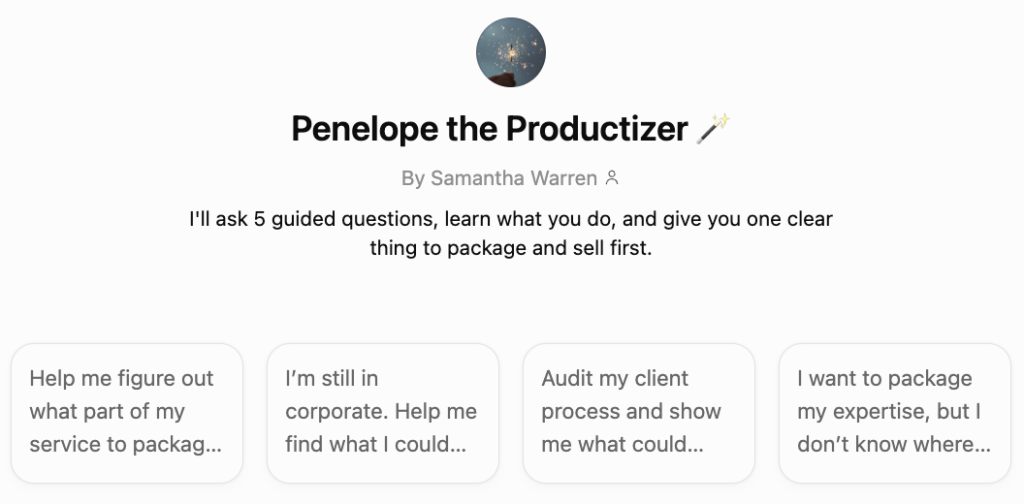
If this post hits a little too close to home, start with Penelope, the Productizer, my free AI-guided audit that asks five real questions and helps you identify one thing in your business you can actually package without trading more time for money. It’s built for the woman who knows she’s valuable, but suspects she’s still too required.
Why this matters if you want freedom without rebuilding your own cage (like mine was)
A lot of women think the problem is that they need a digital product, a course, or some magical passive income setup.
Usually, that’s not the first problem.
The first problem is structural: your business still confuses your personal involvement with your actual value.
Productization is not “build once, sell forever” fantasy land. It’s not passive. It’s not about removing effort. It’s about standardizing the parts that should never have required your constant reinvention in the first place: scope, workflow, decision-making, delivery, and expectations.
Or said more plainly: the goal is not to make your business soulless. The goal is to stop making yourself responsible for every moving part.
1. You are still the sales process
If every sale depends on you personally getting on a call, reading the room, custom explaining your value, and calming someone’s uncertainty in real time, your business still requires you for everything.
That doesn’t mean calls are bad. It means your offer is not carrying enough of its own weight.
What this often looks like
- Every lead needs a custom conversation
- Your pricing changes depending on the person
- You send bespoke proposals for work that is basically the same
- You feel like you are the thing being bought, not the offer
What it usually means
Your sales process is still custom, even if your delivery is not. This is one of the biggest reasons productization “doesn’t work” for service providers: they standardize fulfillment a little, but keep selling like every client is a special exception.
2. Your offer is described in vague words instead of concrete deliverables
If you sell “strategy,” “support,” “optimization,” or “help” without turning that into observable outputs, you’ve left the door wide open for confusion and creep.
Vague promises are expensive.
Better offer language sounds like
- Audit + recommendations
- Messaging teardown
- Homepage copy
- 5-email welcome sequence
- 2-week positioning sprint
People can respect expertise without needing a cloud of abstraction around it. Standardization starts with naming what is actually being delivered.
3. Every client engagement starts from scratch
If your process resets to zero every time a new client comes in, you don’t have a business with leverage yet. You have a business powered by repeated reinvention.
This is especially common with experts. The more you know, the more edge cases you can see. Then customization starts to feel intelligent, even when it’s quietly draining your margin.
Productization does not mean identical
You can standardize:
- Stages
- Intake forms
- Timelines
- Deliverable formats
- Revision rules
- QA checklists
And still allow variation in:
- Tone
- Industry examples
- Complexity tier
- Selected add-ons
That’s the sweet spot. Your craft stays intact. Your nervous system stops being the infrastructure.
4. Clients buy access to you, not a defined outcome
If the hidden promise of your offer is “you get me in your corner for whatever comes up,” your business is still built around access, not a strategic business design that protects your time.
That feels generous. It also becomes a quiet liability.
Signs of access-based offers
- Unlimited Voxer or Slack support
- Loose retainers with shifting asks
- “Pick my brain” energy baked into delivery
- Scope based on relationship, not agreement
There is a difference between being high-touch and being structurally blurry. One builds trust, while the other makes you permanently available.
5. You price around effort, not around a repeatable method
If your pricing still starts with “how long will this take me?” every time, you’re still operating from time-for-money math instead of offer design.
That keeps you trapped in a ceiling-based model.
Why this matters
The real unit in a service business is rarely just time. It’s:
- Throughput
- Lead time
- Context switching
- Revisions
- Client responsiveness
- Complexity
When you have a repeatable method, pricing gets cleaner because the offer itself has shape. Without that, every quote becomes a live negotiation between your worth, your fear, and your calendar. Not ideal…
6. Scope creep keeps sneaking back in
If scope creep is a recurring character in your business, the issue usually isn’t just boundaries. It’s design.
Scope creep returns when:
- The offer language is ambiguous
- Deliverables are not clearly defined
- Revision limits don’t exist
- Client responsibilities are buried in fine print
- You keep making “small exceptions”
And yes, let me say the quiet part out loud: sometimes we reintroduce creep because being needed feels validating.
That doesn’t make you broken. It makes you human. But if your standards only exist when you are actively policing them, they are not standards yet. They’re moods.
7. You keep customizing to prove your value
This is one of the biggest identity tells.
When a woman says, “But it only works because it’s me,” what I often hear underneath that is:
- My value is in my responsiveness
- My value is in my brilliance in the moment
- My value is in seeing what others miss
- My value is in handling the exceptions
Sometimes true. Often overused.
The reframe
Productization isn’t minimizing your expertise; it’s removing the parts that only exist to prove you’re exceptional.
If your offer only works when you personally think through every edge case, you don’t own an offer. You own a dependency.
8. Your quality control lives in your head
If the business only maintains standards because you personally watch everything, catch everything, and remember everything, then quality is still a personality trait, not a system.
That’s exhausting, and it doesn’t scale cleanly.
Quality assurance should be visible
A business that can function beyond your constant vigilance has:
- Checklists
- Templates
- Approval stages
- Acceptance criteria
- A clear definition of done
High standards do not require constant self-sacrifice. That’s an old story. Calm is a form of power, and in business it often looks like operational clarity.
9. Your clients’ lack of readiness becomes your emergency
A productized service breaks quickly when the client side is chaos and you’ve made yourself responsible for absorbing it.
If clients miss deadlines, send incomplete assets, change direction halfway through, or disappear and reappear wanting the same timeline, your business needs stronger structure.
Client responsibilities are part of the product
This includes:
- What they must submit
- When they must submit it
- What happens if they don’t
- What pauses the timeline
- What triggers extra fees or a reset
This isn’t being harsh. It’s being available for the right work in the right conditions.
With a digital product or productized service and an evergreen funnel system working in your favor, you’ll be well on your way to freedom.
10. Your business can’t function without your real-time decision-making
If every question routes back to you, every edge case waits on you, and every process still requires your judgment in the moment, you have not reduced dependency. You’ve just organized it better.
This is where a lot of women mistake better task management for leverage.
Ask yourself
- What decisions repeat weekly?
- Which of those could become rules?
- What am I still deciding live that should already be decided once?
Freedom in business is not about disappearing from responsibility. It’s about no longer spending your energy on predictable decisions.
11. You’re selling recurring work that is still wildly custom
Retainers can look stable while quietly recreating the exact same trap as a job.
Recurring billing is not the same as leverage.
A retainer becomes a constraint when…
- The scope changes every month
- Deliverables are loose
- Communication is constant
- The client expects on-demand thinking
- You are essentially renting out your nervous system
A healthier model often starts by separating the repeatable core from the variable extras:
- Base package = fixed recurring deliverables
- Add-ons = pre-priced variability
- Tiers = complexity control
That is not less premium. It is simply more honest.
12. You secretly believe replacing yourself would make you less valuable
This is the deepest sign, and usually the real one.
A lot of resistance to productization is not tactical. It’s identity-based.
If your business has become proof that you are capable, exceptional, reliable, needed, smart, or safe, then making yourself less required can feel threatening, even if it’s what you say you want.
I say this with love… some women are addicted to how their business validates their personal value. You gotta separate the two.
What needs to change…
You have to be willing to let go of burnout and become available for a new identity:
- Not hero operator, but system designer
- Not exception handler, but standard setter
- Not emotionally available to every opportunity, but selective
- Not needed for everything, but trusted for what matters
You cannot receive at a level you are not being.
What to do if you recognized yourself in these signs
Don’t go burn down your business and announce a complete rebrand by Thursday. (Please don’t!)
Start smaller and cleaner.
Begin here:
- Identify one offer you deliver repeatedly
- Define the concrete outcome it creates
- List what parts are actually repeatable
- Separate core scope from edge-case extras
- Turn live decisions into written rules
- Clarify client inputs, timelines, and revision limits
- Notice where your identity is attached to being the one who “makes it work”
That last part matters. Structure alone won’t hold if your self-concept keeps pulling you back toward over-functioning.
Frequently Asked Questions
Is a productized service the same as passive income?
No. A productized service is usually a standardized service, not effortless income. It has fixed scope, defined pricing, and repeatable workflows. You are still delivering value. The difference is that delivery is structured, not reinvented every time.
Can I productize my business if my work is highly customized?
Probably, yes… but not by making everything identical. The better question is: what is the smallest set of variables that still creates the outcome? You can standardize the backbone of the process while allowing controlled variation in tone, examples, complexity, or add-ons.
What’s the easiest first thing to productize?
For many service providers, it’s a diagnostic offer:
- Audit
- Teardown
- Strategy sprint
- Messaging review
- Roadmap session
These are often easier to shape than a full-service engagement because the scope is naturally tighter and the deliverable is clearer.
How do I know if I’m resisting productization for identity reasons?
A few clues:
- You say “my clients need me” more than you say “my offer works”
- You keep making exceptions that don’t make business sense
- You equate customization with premium
- You feel oddly threatened by the idea of someone else following your process
That usually means the issue isn’t capability. It’s attachment.
The clearest sign your business still requires you for everything is not just that you’re busy.
It’s that the business has no clean way to create results without your constant presence, judgment, flexibility, or rescue energy.
That is fixable, but it requires honesty.
Not every part of your business needs to be automated. Not every offer needs to become a course. And no, the answer is not to chase passive-income fantasy because someone on the internet made it sound chic.
The real glow-up is quieter than that. It’s building a business where your standards live in the structure, your value lives in the method, and your freedom no longer depends on how much of yourself you can keep feeding the machine.
If you want a practical starting point, begin with one question: what part of what I already do doesn’t actually need me?
That’s exactly what Penelope, the Productizer helps you answer. She walks you through five sharp questions and gives you one named starting point you can shape into a real offer, so you can stop confusing your involvement with your value, and start building something that supports your freedom instead of consuming it.
Pin Me to Your Favorite Pinterest Board!