There comes a point in business where the issue is not talent, and it’s not effort either. It’s structure.
A lot of smart women hit that point, actually. On paper, the business is working. Clients are coming in. The invoices are being paid… hallelujah!
But behind the scenes, everything still depends on you translating, customizing, delivering, following up, and holding the whole thing together with your own brain. God, how exhausting!
It looks like freedom from the outside and feels suspiciously like another job from the inside. Did you build your old 9-to-5 into your own business? Maybe that’s a question for another day… LOL.
That’s exactly why productization matters. You need to stop confusing your personal involvement with the actual source of the result.
I learned this the hard way after scaling an agency to 20+ clients and realizing I had built a business that could only grow by requiring more of me. The pivot started with one question: what part of what I already do doesn’t actually need me?
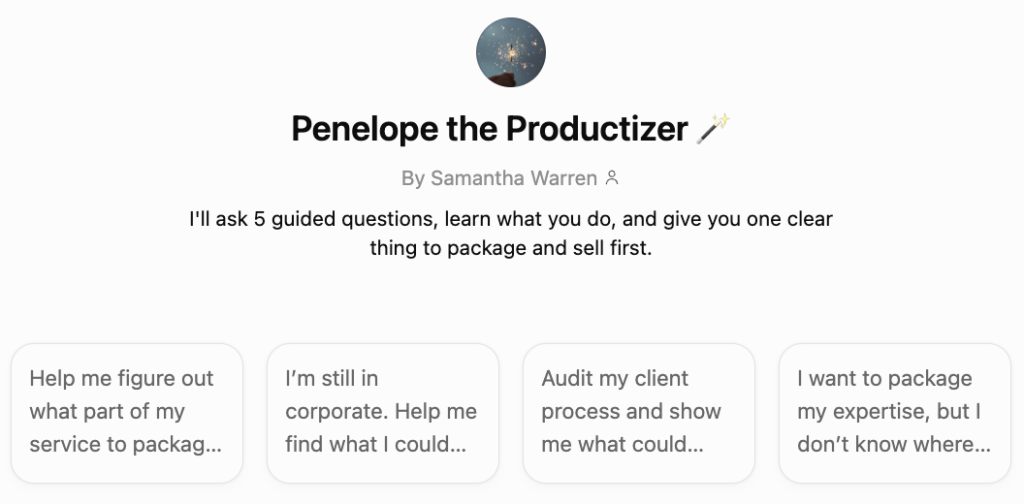
If that’s the question you’re sitting in too, start with Penelope, the Productizer: my free AI-guided audit that helps you identify the one thing in your business you could package into a real offer without trading more time for money. It’s five questions, and you leave with a named starting point instead of more vague ideas.
Why packaging your service matters
Before we get into the 15 ways, here’s the deeper truth: most service providers are not stuck because they need another business model trend. They’re stuck because their identity is still wrapped around being the one who personally makes everything work.
That attachment is real. Research on identity-based motivation suggests we naturally gravitate toward actions that feel congruent with who we believe we are. If your self-concept is “I’m the expert,” “I’m the safe pair of hands,” or “clients get results because I’m in the room,” then packaging your service can feel strangely threatening, even when it’s the obvious next move.
But packaging does not erase your expertise. It clarifies it.
In practice, your expertise usually has three layers:
- Judgment: the high-level decisions only experience can make
- Process: the repeatable sequence you follow
- Artifacts: the templates, frameworks, checklists, scripts, and tools you use
You do not need to package all three at once. You just need to stop delivering all three manually every single time.
1. Turn a custom service into a fixed-scope offer
The simplest way to package a service is to stop selling “anything they need” and start selling one clearly defined outcome.
Instead of:
- Marketing support
- Brand consulting
- Strategy help
Try:
- 30-day content strategy sprint
- Brand messaging intensive
- Funnel audit + action plan
A fixed-scope offer makes the service easier to buy, easier to deliver, and easier to repeat.
What to define
- What’s included
- What’s not included
- Timeline
- Deliverables
- Price
If you are still selling ambiguity, you are still selling access to your nervous system.
2. Productize your audit or diagnostic process
If you already begin client work by assessing what’s wrong, what’s missing, or what needs to happen next, that diagnostic step can often become a standalone offer.
This works especially well because clients pay for clarity faster than they pay for implementation.
Examples:
- Website conversion audit
- Messaging review
- Client journey audit
- Systems efficiency audit
- Offer ecosystem review
The audit is often one of the easiest services to package because your value is in your judgment, not hours of execution.
3. Sell a strategy session with defined outputs
A lot of women are already doing strategy calls informally, underpricing them, or burying them inside larger packages. That’s money sitting on the table.
A strategy session becomes a package when the outcome is specific.
Instead of:
- “Pick my brain”
- “90 minutes of consulting”
Try:
- 90-minute offer refinement session + positioning summary
- Visibility strategy call + 30-day action map
- CEO decision session + priority plan
The key
People are not buying conversation. They are buying compression.
Your lived experience lets you collapse time for someone else. Package that.
4. Turn your repeatable process into a sprint
If you have a service you can complete in a concentrated timeframe, turn it into a sprint model.
This is one of the cleanest ways to package a service because it creates structure without pretending the work is passive.
Examples:
- 2-week onboarding system sprint
- 5-day messaging sprint
- 10-day SOP documentation sprint
- 1-week portfolio positioning sprint
Sprints work because they reduce decision fatigue for both you and the client. Cognitive load matters. Clear structure increases follow-through.
5. Package the deliverables, not your availability
Many services stay messy because the offer is built around your presence instead of the actual assets being created.
A better question is: what does the client walk away with?
That could be:
- A messaging guide
- A set of email sequences
- A dashboard
- A documented workflow
- A headline library
- A launch brief
This shift matters. Clients do not need unlimited access to you. They need a result they can use.
That distinction alone will change how you price.
6. Turn your internal template into a client-facing asset
If you keep recreating the same checklist, worksheet, framework, or onboarding document behind the scenes, you already have the beginnings of a packaged offer.
This is where tacit knowledge becomes explicit. The thing you “just know how to do” gets translated into something visible, transferable, and repeatable.
Examples:
- Discovery questionnaire becomes a paid clarity workbook
- Internal content planner becomes a mini planning system
- Client onboarding doc becomes an onboarding setup package
- Review rubric becomes a brand messaging scorecard
A lot of your “magic” is simply undocumented.
7. Create a tiered version of the same service
Not every client needs the full bespoke version of your work. Some need a lighter entry point.
You can package one service into tiers like this:
- Lite: audit or review only
- Core: audit + strategy
- Premium: strategy + implementation support
This lets you serve different readiness levels without reinventing your business every time someone inquires.
It also helps separate what truly requires your direct expertise from what can be delivered in a more standardized way.
8. Offer a done-with-you version instead of only done-for-you
If your current service is fully dependent on you doing the work, a done-with-you package can create leverage while preserving quality.
Examples:
- Monthly messaging co-working intensives
- Offer refinement workshop + templates
- Tech setup with guided implementation
- Content planning call + plug-and-play system
This is especially useful if clients do not actually need you to perform every step. They need your structure, your eye, and your sequencing.
That is a very different thing.
9. Build a signature framework around the service
People buy clarity. Frameworks create clarity.
If your service currently sounds like a list of tasks, give it a method. A recognizable framework helps clients understand how you work and why it works.
For example, in my Paid to Be Her movement, my own business philosophy became clearer when I rebuilt around Identity, Structure, and Receiving. This is a way of making transformation communicable.
A strong framework usually includes
- 3 to 5 stages
- A logical sequence
- A distinct lens or methodology
- Language your client can repeat
This is also where your authority becomes easier to signal without you having to overperform.
10. Turn recurring client education into a hybrid offer
If you find yourself explaining the same concepts inside client work, that education can become part of a package.
Think:
- Loom library + implementation call
- Training vault + monthly office hours
- SOP library + setup session
- Mini course + custom review
This is the honest version of leverage. Not “build once, sell forever.” More like: build once, refine responsibly, and keep the offer supported.
That’s a much calmer business model, and frankly, a more adult one. 😉
11. Package one phase of your service as a standalone entry point
You do not need to package the entire transformation immediately. Often, one phase is enough.
Examples:
- Research phase
- Setup phase
- Audit phase
- Messaging phase
- Optimization phase
This works well if your current service is high-ticket and complex. A standalone first phase gives clients an easier yes and gives you a cleaner sales process.
It also lets you prove your method before asking for deeper commitment.
12. Turn your retainer into a menu of standardized offers
If your business model relies on retainers that slowly become vague, emotional, and overstuffed, this one is for you.
You can often unbundle the retainer into a set of standardized packages such as:
- Monthly reporting package
- Quarterly strategy intensive
- Launch support sprint
- Content planning system
- Offer optimization review
I say this with love: many retainers are just poorly defended boundaries wearing a professional outfit.
Packaging restores standards.
13. Create a small, specific problem-solver offer
Not every packaged service needs to be a big transformation. Some of the best ones solve one irritating, expensive, recurring problem.
Examples:
- LinkedIn bio rewrite
- Welcome email sequence setup
- Notion dashboard build
- Proposal template makeover
- Sales page teardown
Small problem-solvers work because they are easy to understand and easy to refer. They can also become the cleanest bridge between service work and a more scalable offer ecosystem.
14. Package your methodology for a specific niche
Sometimes the service is not too broad because the work is vague. It’s too broad because the audience is.
A service becomes easier to package when it is tied to:
- One type of buyer
- One type of problem
- One type of desired result
For example:
- SOP sprint for agency founders
- Messaging intensive for executive coaches
- Funnel audit for course creators
- Onboarding system setup for consultants leaving corporate
Specificity reduces friction. It also increases trust, which matters because clients are not only buying the method. They are buying risk reduction.
15. Start with the part that doesn’t actually need you live
This is the most important one because it is the one most women avoid.
Ask yourself:
- What do I repeat in almost every client engagement?
- What am I customizing out of habit, not necessity?
- What part of my process could still work if I wasn’t personally performing it in real time?
- Where am I the bottleneck?
- What am I doing manually because it validates my identity as “valuable”?
That last question stings a little, which usually means it’s useful.
Packaging starts here. Not with some fantasy of disappearing from your business, but with enough self-honesty to admit that your over-involvement is not always the same thing as excellence.
How to choose which service to package first
If you have seven ideas and no decision, use these filters:
Package the service that is:
- Repeated often
- Easy to describe
- Linked to a clear outcome
- Currently draining more time than it should
- Partly process-driven, not entirely judgment-driven
Avoid packaging first:
- Work that changes wildly from client to client
- Offers with no clear scope
- Services you secretly want to stop doing
- Something trendy you do not actually want to maintain
Alignment matters here. So does reality.
You cannot receive at a level you are not being. If you say you want freedom but keep building offers that require constant rescue mode, your structure is contradicting your desire.
Frequently Asked Questions (FAQs)
Can I package a service if my work is highly customized?
Yes, usually part of it.
You may not be able to package the full transformation immediately, but you can almost always package one element:
- the audit
- the kickoff
- the roadmap
- the templates
- the implementation framework
Your work does not need to become generic. It needs to become clearer.
What’s the difference between a productized service and a digital product?
A productized service still includes active delivery, but with fixed scope, defined outcomes, and repeatable structure.
A digital product is more asynchronous and usually relies more heavily on content, education, or tools.
The better starting point for many service providers is not “create a course.” It’s “standardize what already works.”
Will packaging my service make it feel less premium?
Not if it is done well.
In most cases, packaging increases perceived value because it:
- makes the result easier to understand
- reduces buyer uncertainty
- shows professionalism
- protects quality through consistency
Messy customization is not the same thing as premium.
How do I know if I’m the bottleneck in my business?
If every sale creates a new chain of manual decisions, custom delivery, emotional labor, and after-the-fact adjustments, you are likely the bottleneck.
That does not mean you are the problem. It means your business still depends too heavily on your direct involvement.
That is fixable.
Packaging your service is a self-trust move
It’s about separating your real value from your unnecessary overextension.
This process asks you to believe that the result is not only happening because you are burned out, overavailable, and manually touching every part of the process because it requires you for everything. It asks you to become the designer of the result, not just the person performing it on demand. Calm is a form of power, and in business, calm usually comes from structure.
If you want help identifying the best starting point to design your business for freedom, use Penelope, the Productizer. She’ll walk you through five questions based on the same reframe that changed my own business: what part of what you already do doesn’t actually need you?
You’ll leave with one shaped, named idea you can build from, instead of another open loop in your Notes app.
Save me to your favorite Pinterest board!