
There is a difference between having expertise and having something that can actually be packaged.
A lot of smart women get stuck here. They think the magic is in how hard they work, how available they are, how many details they can hold, how quickly they can step in and save it.
I know that pattern because I built a business on it. I scaled a marketing agency to 20+ clients by saying yes too often and being needed for too much. It worked, until it didn’t.
The question that changed everything for me last year was not what should I sell?
It was: what part of what I already do doesn’t actually need me? That is a very different question, and it leads to a much calmer business.
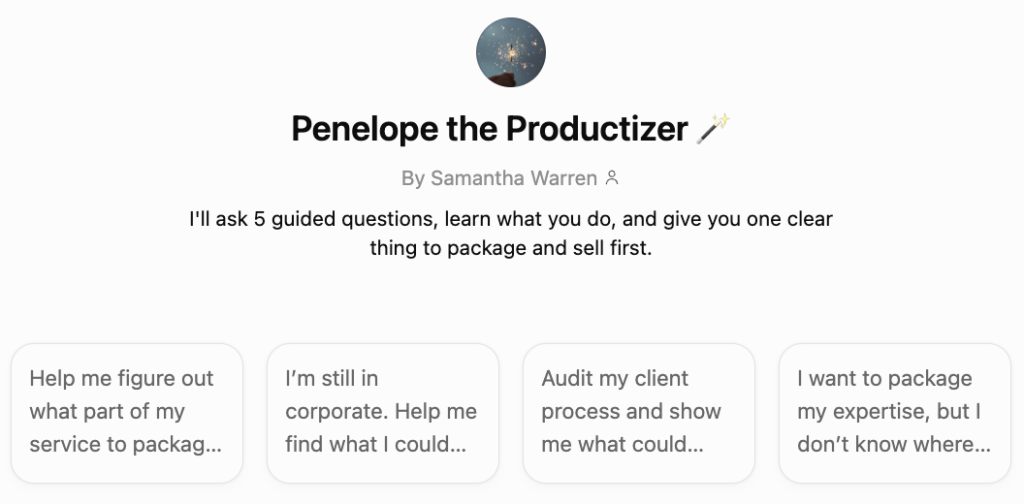
If you want help answering it in real time, start with Penelope, the Productizer, my free AI-guided audit that helps you identify one thing in your business you can package without adding more hours. It is built around the same reframe: your value is not the same thing as your constant presence.
Why this audit matters before you build anything
Before you package an offer, record a course, or turn your process into a shiny new asset, you need discernment.
Because productization is not just a content exercise. It is an identity exercise, an operations exercise, and a standards exercise.
A lot of women are trying to package too early, from the wrong place:
- from burnout
- from urgency
- from copycat strategy
- from the hope that a digital product will rescue a business model they do not actually trust
That is how you end up with a half-built offer, a Google Drive full of worksheets nobody asked for, and a low-level resentment toward your own business.
This six-way audit is here to prevent that.
1. What specific result do people repeatedly come to you for?
Before you package anything, strip away the vague language.
Not “clarity.”
Not “support.”
Not “strategy.”
Not “alignment,” if we are being honest.
Ask yourself: what is the tangible result people reliably seek from me?
The best productized offers are built around recurring demand, not personal attachment to an idea.
What to look for
You want a result that shows up across clients, conversations, or past work:
- a repeated bottleneck you solve
- a common decision you help people make
- a pattern you spot quickly
- a transformation that does not depend on reinventing your process every time
For example, a leadership coach may think she sells confidence. But what clients actually buy is:
- better decision-making in high-stakes conversations
- reduced rumination before meetings
- clearer communication under pressure
That is much more packageable.
Why this works
This is partly a cognition issue. Buyers are overloaded. Research on working memory suggests we process only a limited number of chunks at once, which is why simpler, clearer offers tend to land better than sprawling ones. In practice, if someone can quickly understand the result, they are more likely to trust the path.
2. Which part of your expertise is judgment, and which part is repeatable?
This is where most service providers get tangled.
They assume productization means writing down everything they do. It doesn’t.
Your expertise likely includes two different things:
- Judgment: pattern recognition, prioritization, nuance, knowing what matters
- Repeatable process: steps, frameworks, templates, decision trees, reviews
Those are not the same.
The real issue: tacit knowledge
A lot of what experts do is tacit. It lives in your nervous system, your pattern recognition, your lived experience. You may not even realize how quickly you are making decisions because it feels obvious to you.
That is why “just turn it into a course” is usually terrible advice.
Research on tacit versus explicit knowledge, including Nonaka’s work on knowledge creation, helps explain this. Experts do not naturally think in neat modules. They often work through situational judgment first, then action second.
The practical reframe
Do not ask:
- How do I package all of me?
Ask:
- What part of my thinking can be safely translated into a repeatable asset?
That is the beginning of productization.
3. What must stay live, and what are you only doing live out of habit?
This is one of my favorite questions because it cuts through a lot of performance.
Not everything belongs in a self-serve product. Some things genuinely require live support. But plenty of women are still doing low-risk, repeatable tasks live simply because their identity is attached to being the one who delivers them.
Use the three-layer delivery model
Audit your work across these three layers:
Live
Best for:
- diagnosis
- prioritization
- real-time feedback
- stakeholder dynamics
- anything high-risk or high-judgment
Guided
Best for:
- async reviews
- milestone check-ins
- structured audits
- implementation support with boundaries
Self-serve
Best for:
- onboarding
- templates
- checklists
- SOPs
- tutorials
- calculators
- decision trees
The question is not whether you can be involved. The question is whether your involvement materially improves the outcome.
If not, it probably belongs in guided or self-serve delivery.
Some thoughts from my personal experience…
Freedom without structure feels like anxiety. I learned that not just in business, but in life. Since becoming location-independent and living as a digital nomad, I have seen this everywhere: more freedom requires more internal clarity. Business is no different. The more spacious you want your model to become, the more intentional you have to be about where your energy is actually required.
4. Are you packaging a proven pattern, or trying to package your potential?
This one is personal for a lot of women.
Sometimes we try to package what sounds elevated rather than what is already proven. We want the polished signature method before we have enough evidence that the method reliably works.
It is very easy to package your aspiration.
It is much wiser to package your pattern.
Signs you are packaging too early
- you cannot point to repeated client results
- every engagement still looks wildly different
- your process changes completely depending on your mood
- you are more excited by the sales page than the delivery
- you secretly hope the offer will make you feel more legitimate
Respectfully: that is not productization. That is emotional outsourcing.
What to package instead
Start with what already has:
- repeat demand
- visible client friction
- a recognizable before-and-after
- enough consistency to shape into a framework
This is where self-trust matters. You do not need to overinflate your offer to make it valuable. You need to tell the truth about what already works.
Calm is a form of power here.
5. What identity are you protecting by keeping everything custom?
This is the question that makes people exhale or get slightly defensive. Usually both.
Because sometimes the resistance to productizing is not strategic. It is emotional.
You may be protecting:
- artistry
- control
- intimacy with clients
- status as “the one who always knows”
- the belief that being needed equals being valuable
I say that with no judgment. I have lived it.
When I ran my agency in a more reactive season, the business depended on me for almost everything. That looked successful from the outside.
Internally, it was a ceiling. The business could only grow to the level my time, energy, and emotional capacity could hold.
The reason this feels so loaded (& what the research says)
Identity-based motivation research shows that people are more likely to act when something feels congruent with who they believe they are. The flip side is also true: when a smart strategic move feels like an identity threat, we resist it.
So if your identity is:
- “I am valuable because I personally deliver brilliance”
then packaging that brilliance into assets can feel like losing yourself.
But you are not losing yourself.
You are separating identity from delivery.
That is a standard.
That is self-respect.
That is how you stop building businesses that require self-abandonment to survive.
6. What asset could carry your expertise without requiring your constant presence?
This is where the audit becomes useful, not just insightful.
You do not need to package everything. You need to identify one asset that can act as a bridge between your expertise and someone else’s action.
In research language, this is close to the idea of a boundary object: an artifact that helps transfer knowledge across contexts. In plain English, it means something your client can use that carries your thinking, even when you are not there live.
Three strong starting points
Most service providers can begin with one of these:
Diagnostic
An assessment, audit, scorecard, or intake tool that identifies the real problem and points to next steps.
Good for:
- consultants
- coaches
- strategists
- brand and messaging experts
Template or SOP
A repeatable structure that standardizes part of the work.
Good for:
- agencies
- operations experts
- marketers
- OBMs
- designers with process-heavy delivery
Feedback system
A rubric, review process, or quality-control framework that helps clients self-correct or improve with consistency.
Good for:
- editors
- educators
- leadership coaches
- service providers with iterative work
What honest productization actually looks like
Let’s be adults for a second.
This is not “build once, sell forever.”
This is not “set it and forget it.”
This is not passive-income cosplay with nicer fonts.
A productized offer still needs:
- positioning
- trust-building
- maintenance
- refinement
- customer support
- active marketing
The honest win is not that you remove all work.
The honest win is that you remove unnecessary personal involvement.
That creates:
- more consistency
- less emotional labor
- stronger pricing integrity
- cleaner delivery
- more room to receive without chaos
And yes, that is energetic too. Because aligned business is not just what sounds good. It is what your nervous system and your calendar can both hold. That’s how manifestation in business works.
Common mistakes to avoid before you package anything
Here are a few mistakes I see often with my clients:
Packaging too broad a promise
Specific beats impressive.Turning high-judgment work into self-serve too soon
Not everything should be automated or distilled.Keeping simple things custom to feel premium
Sometimes custom is just inefficient with better branding.Confusing your presence with your value
They are related, not identical.Building from hype instead of proof
If the business model sounds better than it feels, pay attention.
Frequently Asked Questions (FAQs)
How do I know if I am ready to package my service?
You are likely ready if you can identify a repeated problem you solve, a pattern in how you solve it, and a portion of the delivery that does not require your real-time judgment every single time. You do not need a perfect method. You need enough repeatability to shape one part of your expertise into an asset.
What if my work is too customized to productize?
Some of it may be. That is fine. Productization does not require turning your entire business into a self-serve library. It often starts by extracting one repeatable piece: diagnosis, onboarding, templates, reviews, or a structured framework. The goal is not to erase nuance. It is to stop performing repeatability manually.
Is productization the same as creating a digital product?
No. A digital product is one format. Productization is broader. It is the process of making part of your expertise more structured, transferable, and less dependent on your constant involvement. That might become a digital product, a guided audit, a standardized service, or a hybrid offer.
What if I am still in corporate and have not started a business yet?
Then this audit is still useful. In fact, it may be even more useful. If you have unextracted expertise sitting inside your role, these questions help you identify what could become a future offer. A lot of women are more experienced than they realize; they just have not separated their skill from the container they learned it in.
Before you package anything, tell yourself the truth.
Not everything you do should become an offer. Not every skill should be self-serve. Not every part of your brilliance needs to be translated. But somewhere inside your work, there is almost always a piece that can be shaped, named, and delivered with less strain.
That is the real shift.
Productization is not about becoming less valuable. It is about becoming less entangled. It is about building a business where your standards are clear, your delivery is clean, and your income is not capped by how much of yourself you can hand over in a day.
If you want a grounded place to start, use Penelope, the Productizer. She walks you through five real questions and helps you identify one specific thing in your business that can be packaged without confusing your personal involvement for the value itself. It is a clearer first step than guessing, and a lot calmer than building another offer from pressure.
Pin Me on Pinterest!