
I see you. You’re working. You’re posting. You’re changing things. You’ve tried the intensive, the retainer, the mini offer, the template, the workshop, the membership concept sitting in your notes app like a hostage situation. Technically, you’re moving.
But if we’re honest, a lot of that movement is the equivalent of rearranging furniture… pretty useless.
Format-hopping feels productive because it lets you stay in decision mode instead of construction mode.
You get to keep asking, Should this be a course? A template? A VIP day? A voice note offer?
Meanwhile, the real question goes untouched: what part of your value actually works without your constant personal involvement?
I know this pattern because I’ve lived the business version of it. Before Paid to Be Her, I built a marketing agency to 20+ clients by saying yes too often and making myself the instrument of every result. It worked until it didn’t.
The question that changed everything wasn’t “what should I sell next?” It was: what part of what I already do doesn’t actually need me? That question is still the one.
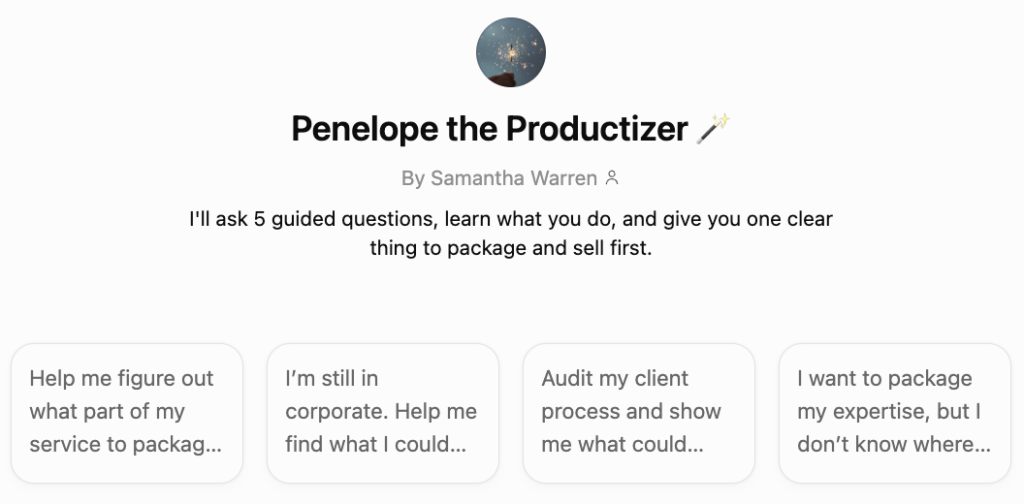
If you want help answering it in your own business, try Penelope, the Productizer: my free AI-guided audit that walks you through five questions and gives you one clear, named starting point before you leave the chat.
Why format-hopping keeps even the savviest businesswomen stuck
Many of the women I mentor are confused because they’re still emotionally attached to being the one who makes the magic happen live. So instead of building a business asset, they keep swapping containers.
And to be clear, the container does matter. A diagnostic offer is different from an implementation package. A training kit is different from a retainer. But changing formats too early often becomes a very polished form of avoidance.
Productization is about translating your value out of pure live performance and into something that can be delivered more cleanly, more consistently, and with more self-respect.
So, here are a few signs you’re still getting distracted by shiny objects instead of building what you need to build…
1. You keep renaming the offer, but the delivery is still entirely dependent on you
A new name can feel like momentum. Sure, sometimes it is.
However. If every version of your offer still requires:
- your real-time judgment
- your custom thinking from scratch
- your constant availability
- your emotional labor to hold the whole thing together
then you have not built a new business model. You’ve just slapped a new name on the old one, but it won’t fix your burnout or lack of freedom in your own business.
What building would look like instead
You start asking:
- Which parts are repeatable?
- Which decisions happen every time?
- Which inputs produce predictable outputs?
- Where am I adding value, and where am I adding unnecessary presence?
2. You’re solving boredom, not a business constraint
Let me say this kindly: not every urge to pivot is intuition.
Sometimes you’re just bored… LOL!
Women with a lot of capability often mistake restlessness for misalignment. But boredom is not, by itself, a reason to rebuild the offer. Sometimes it’s just what shows up when your business needs refinement instead of reinvention.
If you can’t clearly name the actual constraint, you’re probably format-hopping.
Real constraints sound like:
- “This offer has too much delivery variance.”
- “Scope creep is killing profitability.”
- “Client onboarding is messy.”
- “I can’t separate premium judgment from standard execution.”
- “This works, but it only works at my current capacity.”
Vague pivot energy sounds like:
- “I think I need something more scalable.”
- “I’m over this format.”
- “Maybe people just want a lower-ticket version.”
- “I need a more passive income stream.”
Respectfully, the internet has done enough damage there.
3. You haven’t codified your method, so every new format is still custom underneath
This is one of the biggest tells.
If you haven’t extracted your method, no offer format will save you. A course built on unclear thinking becomes a confusing course. A VIP day built on unclear thinking becomes a long, expensive improv session. A template built on unclear thinking becomes a support inbox.
A lot of service providers are carrying tacit expertise… the kind of knowledge that lives in instinct, experience, pattern recognition, and “I just know.” That expertise is real. It’s also hard to scale until you make it explicit.
Codification before container
Before you ask whether this should be:
- a digital product
- a workshop
- a productized service
- a licensing or enablement kit
ask:
- What problem do I solve repeatedly?
- What sequence do I naturally follow?
- What standards do I use to evaluate what’s working?
- Which pieces require my highest judgment, and which don’t?
The format comes after the method. Not before.
4. You’re chasing leverage, but ignoring distribution
This is where a lot of “passive income” fantasies quietly fall apart.
Even a great leveraged offer still needs:
- positioning
- demand validation
- distribution
- onboarding
- support
- updates
- refinement over time
The labor changes. It doesn’t disappear.
When someone keeps changing the format, sometimes what they’re really avoiding is the more exposed part of business building: staying visible long enough for the right people to understand what the offer is for.
The honest version of leverage
Leverage usually means shifting from delivery labor to commercialization labor.
You do less bespoke hand-holding, yes. But you do more:
- asset creation
- message refinement
- channel building
- system maintenance
- offer iteration
That is still work. Just cleaner work.
And clean is underrated.
5. You keep lowering touchpoints when what actually needs fixing is the scope
This one is subtle.
A lot of women assume the answer to burnout is making the offer more hands-off. Fewer calls. More videos. More automation. Less access. Sometimes that’s right. Sometimes it just creates a colder version of the same unclear offer.
If the scope is messy, distance won’t save it.
You cannot automate your way out of:
- bad fit clients
- vague outcomes
- inconsistent inputs
- overpromising
- unclear boundaries
I learned this the hard way in agency life. My burnout was not just caused by volume. It was caused by a model that let too much depend on me, too often, with too few constraints. The fix wasn’t to vanish. The fix was to rebuild around structure.
Better question
Instead of asking, “How do I make this lower touch?”
Ask:
- “What should never have been custom in the first place?”
- “What part of this process can be standardized without lowering integrity?”
- “Where am I confusing proximity with value?”
That’s a very different conversation.
6. You’re making offer decisions from identity panic, not evidence
Format-hopping often spikes when your current business identity stops feeling stable.
Maybe you left corporate and no longer have the title, structure, and external validation that used to make you feel clear. Maybe you left a service business model that once worked, but now feels claustrophobic. Maybe you’ve outgrown the version of success that depended on being needed all the time.
That identity transition is real. But if you don’t see it clearly, you’ll start making reactive decisions that look strategic.
Examples:
- You build a course because you’re tired of clients, not because the method is ready.
- You launch a retainer because it feels safer, not because the economics make sense.
- You create a low-ticket offer because you’re scared your premium work won’t hold.
- You pivot every quarter because staying still long enough to compound feels unbearable.
Freedom without self-trust feels like anxiety. So does entrepreneurship without structure.
This is why my Paid to Be Her movement is so focused on identity and infrastructure together. You cannot build calmly if every business decision is secretly trying to regulate your self-worth.
7. You still haven’t answered the one question that matters most
Here it is again, because it deserves to haunt you a little:
What part of what you already do doesn’t actually need you?
Not your personality.
Not your reassurance.
Not your live presence.
Not your over-functioning.
Not your old habit of proving your value through effort.
Just the part that can stand up as an asset.
That might become:
- a diagnostic offer
- a standardized implementation package
- a workshop with a clear decision outcome
- an internal enablement kit
- a methodology your clients can use with support
- a productized service with fixed inputs and fixed outputs
But the point is not to pick the prettiest format. The point is to identify the repeatable value underneath it.
If you can’t answer that yet, that’s the work
Not more brainstorming.
Not another offer map.
Not another “what should I sell?” spiral.
The work is extraction.
Because you do not need more ideas. You need a cleaner relationship to your own expertise.
How to stop format-hopping and start building
If you want a practical reset, start here:
Audit your current offer for repeatability
What happens every single time, regardless of client?Track delivery variance
Where does the process become unpredictable, bloated, or overly custom?Separate judgment from execution
Which parts need your expertise, and which parts need a system?Choose one constraint to solve
Not your whole business. One real bottleneck.Build the smallest useful asset first
One clean, clear, transferable piece.
That is how calm businesses get built. Not through constant reinvention, but through standards.
FAQ
What is format-hopping in business?
Format-hopping is when you keep changing the container of your offer — course, template, VIP day, membership, retainer, workshop — without addressing the underlying delivery model, method, or business constraint. It creates motion without real infrastructure.
How do I know if I need a new offer or just better systems?
If the core transformation is strong but delivery feels messy, inconsistent, or too dependent on you, you likely need better systems and codification first. If demand is unclear and the problem itself isn’t well defined, then the offer may need a more fundamental rethink.
Is productization the same as making a digital product?
No. Productization simply means making your expertise more structured, repeatable, and less dependent on bespoke delivery. That can look like a productized service, a diagnostic, an implementation package, a workshop, an enablement kit, or a digital asset.
Can you productize expertise without becoming an influencer?
Absolutely. Especially if your background is in operations, marketing, HR, finance, strategy, or enablement. Many women don’t need to become content machines. They need to extract their method and package professional infrastructure in a way buyers can clearly understand and use.
Why do smart women get stuck in format-hopping?
Usually because the issue is not intelligence. It’s self-trust, identity transition, and over-attachment to being personally involved in every outcome. When your value has always been tied to being excellent live, building assets can feel vulnerable. But that doesn’t mean it’s not the next move.
So what now?
If this post showed you that the real issue isn’t choosing the “best” format but identifying the part of your business that can stand without you, go use Penelope, the Productizer. She’ll walk you through five sharp questions and give you one named, shaped starting point that you can create once and sell forever… rooted in the same reframe that changed my business: what part of what you already do doesn’t actually need you?
Pin me on Pinterest!