
You can say “I am abundant” in the mirror every morning and still send a discount to the first client who hesitates on your price. I know this pattern well, because I spent years making business decisions from scarcity. Your affirmations say one thing, your decisions say another, and if you’re wondering why your manifestations keep stalling, those decisions are the most honest information you have.
That’s what self-concept manifestation is really about. Your self-concept is how you see yourself, and in manifestation, it’s the idea that you tend to receive what matches who you believe you are. So if you want something new, the work is to become the version of you who already has it, and you can see exactly where you are with that by looking at what you do with your money, your pricing and your visibility.
In this post, I’ll explain what self-concept means (in manifestation and in psychology), why it shows up in your business before your bank account, why affirmations alone often don’t shift it, how to run a ChatGPT audit that finds your current self-concept from your real decisions, and how to actually shift it.
What self-concept manifestation actually means
In the manifestation world, self-concept comes mostly from Neville Goddard’s teachings and the law of assumption: the idea that your outer world reflects what you assume to be true about yourself. Change the assumption, and the outer world follows.
In psychology, self-concept is simply your set of beliefs about who you are: what you’re like, what you’re good at, what you deserve and what’s “normal” for someone like you. Psychologists have studied it for decades, and the two worlds agree on one important thing. Who you believe you are shapes what you notice, what you try, what you tolerate and what you walk away from.
I’m practical with a dash of woo-woo over here, so here’s how I hold both. I believe in the energy of it, and I also think the most useful part of self-concept work is that you can see it in your behavior and change it through your behavior. That’s what the rest of this post is about.
Why your self-concept shows up in your business before your bank account
When I started my agency, I said yes to every client and made decisions from scarcity. On paper, things were growing (I scaled to 20+ clients at once), and I still kept running into the same wall. Eventually I realized I had confused being flexible with being available, and when I rebuilt my business, I started with the version of me who was running it, and then the offers and systems around her.
That’s what I mean when I say self-concept shows up in your business first. Before it shows up as a number in your account, it shows up as a pattern in your decisions. I call these identity leaks: a pattern you keep repeating that quietly contradicts what you say you want, like discounting when you’re trying to earn more.
Here are some common ones I see in women building businesses:
- Discounting before anyone asks. The self-concept underneath: “I have to make it easy for people to say yes to me.”
- Overdelivering on every project. Underneath: “I have to earn my price, every single time.”
- Hiding from visibility. Underneath: “If people really see me, they’ll judge me.”
- Saying yes to clients who aren’t a fit. Underneath: “I can’t afford to be picky.”
- Apologizing in sales emails. Underneath: “My offer is an inconvenience.”
What the research says: why you keep recreating the familiar
If you’ve ever wondered why you keep landing in the same pattern even when you want something different, psychology has a name for part of it: self-verification. In a set of studies, researchers found that people seek feedback that confirms how they already see themselves, and that includes seeking out unflattering feedback about the parts of themselves they see negatively (Swann, Pelham & Krull, 1989).
That’s a lab study, so I’d hold it lightly, and I still find it really clarifying. It suggests that part of us is wired to stay consistent with the old self-concept, even when that old self-concept is costing us. So if you see yourself as “the affordable one,” a part of you will keep finding ways to be the affordable one. That’s why self-concept work feels uncomfortable: you’re asking yourself to act out of character on purpose until the new character feels normal.
Why affirmations alone don’t shift your self-concept
Affirmations are the most common self-concept advice out there, and I have a complicated relationship with them. In one study, people with low self-esteem who repeated “I’m a lovable person” actually felt worse, and people with high self-esteem felt only slightly better (Wood, Perunovic & Lee, 2009).
That study used short-term mood measures, so it’s one piece of the picture, and it matches what a lot of us have felt: when an affirmation is too far from what you currently believe, repeating it can remind you of how far away you are. Your brain argues back.
So I use affirmations differently. I keep them close to believable, I attach them to a behavior (“I’m a woman who sends her full-price proposal” right before I send one), and I treat my actions as the stronger evidence. If you want help writing affirmations built this way, start with these ChatGPT prompts that rewire your self-concept.
Self-concept vs self-esteem vs self-worth
These three get mixed up a lot, so here’s how I’d separate them. Self-concept is your overall picture of who you are (“I’m a business owner who undercharges”). Self-esteem is how you feel about that picture (good, bad, mixed). Self-worth is your sense of whether you deserve good things, separate from what you do. You can have decent self-esteem and still have a self-concept that keeps you small in one specific area, like money. That’s why I like working on self-concept one area at a time.
How to find your current self-concept from your own decisions
Most self-concept advice tells you to journal on “Who am I?” I love journaling, and I’ve found that question is too big to answer honestly. Your decisions are a much better source, because they show what you actually believe when it counts.
Here’s the audit I’d do with ChatGPT.
Step 1: Write down your last 10 decisions about money, pricing, clients and visibility. Small ones count: the discount, the post you didn’t publish, the call you said yes to, the invoice you sent late.
Step 2: Paste them into ChatGPT with this prompt.
Prompt: “Here are 10 recent decisions I made about money, pricing, clients and visibility: [paste]. For each one, tell me what ‘I am’ belief it implies (for example, ‘I am someone who has to make it easy for people to say yes’). Then group them and tell me the two or three beliefs that show up most. Be direct, and don’t soften it.”
Step 3: Ask for the contrast.
Prompt: “Here’s who I want to be: [describe her in two or three sentences]. Compare her to the beliefs you just found. Where’s the biggest gap, and what’s one decision this week where I could act like her instead?”
It’s genuinely a little confronting the first time, and that’s how you know it’s working. If you want a guided version of this, the free Identity Leak Audit walks you through finding exactly where your identity is blocking your money, using ChatGPT as your guide. And if you’re new to using ChatGPT this way, everything you need is in The Ultimate Guide to Manifesting with ChatGPT.
How to shift it: become her through repeated actions
Here’s the part I wish someone had told me earlier. You get to act like her before you feel like her. Your self-concept updates when you collect evidence, and the fastest way to collect evidence is to make one decision at a time the way she would.
There’s research that supports pairing a future identity with concrete actions. In a school-based program, students who connected a picture of their possible future self to specific strategies for getting there had better grades, test scores and attendance over two years than a control group (Oyserman, Bybee & Terry, 2006). That study was with 8th graders, so it’s a long way from your business, and the principle carries over really nicely: a future identity works best when it’s tied to what you’ll do next.
Here’s how I’d do it:
- Pick one area. Choose money, clients, visibility or pricing, and work on one at a time.
- Name her decision. What would the woman you’re becoming decide in the exact moments where your old pattern shows up?
- Write an if-then plan. “If a client hesitates on my price, then I’ll say ‘totally understand, take your time’ and wait.” Keep it short, specific and ready before the moment comes.
- Collect the evidence. Every time you make her decision, write it down. That list becomes your new self-concept in writing.
- Expect discomfort. Acting out of character feels weird at first. That feeling usually means you’re doing it right.
If you want to go deeper on the future-self side of this, I walk you through it in How to Use ChatGPT for Future Self Journaling.
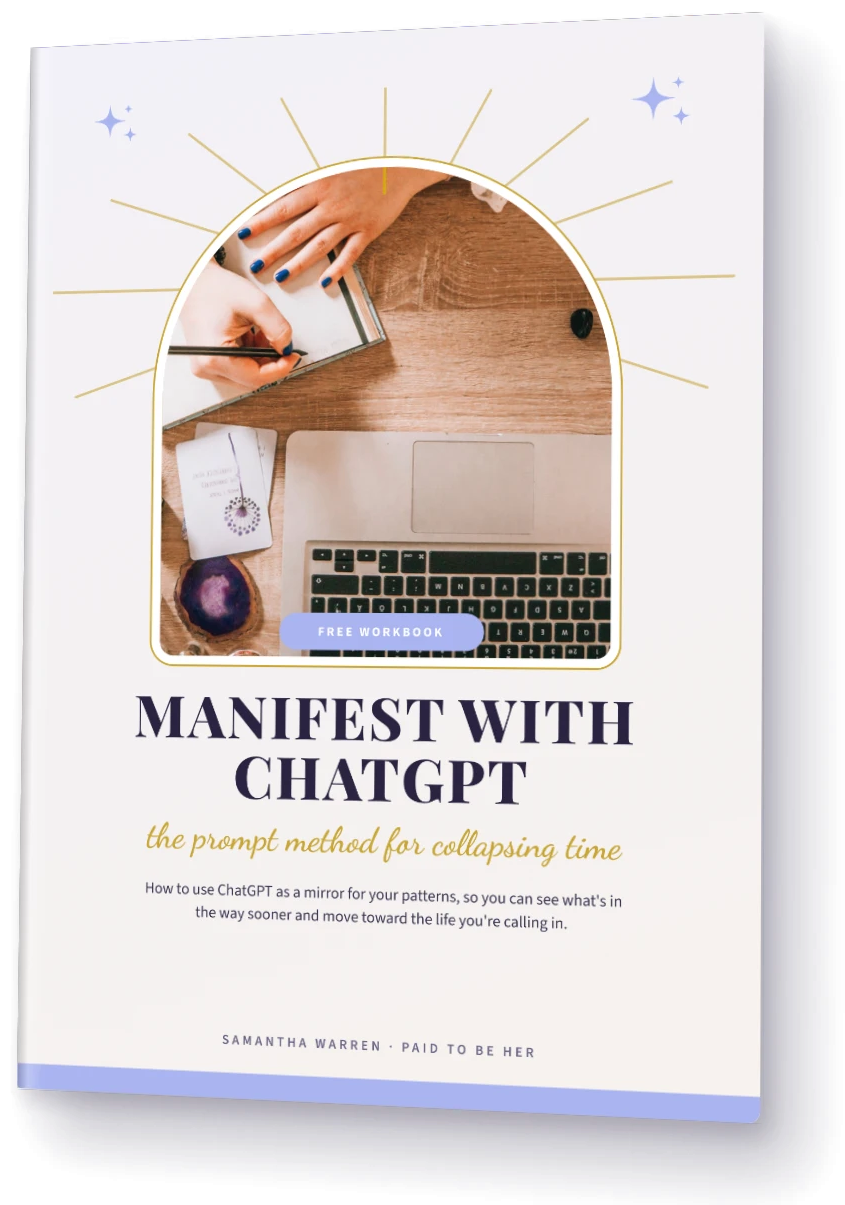
Get the free Manifest with ChatGPT workbook
If the audit above clicked for you, you’re going to love my free workbook, Manifest with ChatGPT. My manifestation process has changed a lot in the last couple of years, so I made it brand new, and it picks up right where this post leaves off. The identity leaks stack inside goes even deeper on finding the self-concept behind your decisions.
Here’s what’s inside:
- The setup prompt that tells ChatGPT who you are and what you’re calling in, so it stops handing you generic answers.
- My 5-part prompt formula, so you can write your own prompts (like your own version of the decision audit) that sound like you.
- 6 prompt stacks for desire, belief, evidence, identity leaks, behavior and feedback.
- A follow-up toolkit for when ChatGPT’s first answer isn’t quite it.
- Notes pages so your decision list, if-then plans and evidence list live in one place.
Pop your email in below and it’s yours.
Before and after: self-concept shifts in money and business
Here’s what this looks like in real decisions. These are examples, so swap in your own.
- Pricing: Before, she quotes a number and immediately offers a payment plan “if that’s too much.” After, she quotes the number and waits.
- Clients: Before, she says yes to every inquiry because she’s scared of an empty month. After, she has two questions she asks on every call to check fit, and she refers out the ones who aren’t.
- Visibility: Before, she drafts posts and deletes them. After, she posts three times a week, even when it feels a little exposed.
- Receiving: Before, she brushes off compliments and says “it was nothing.” After, she says “thank you, I worked hard on that.”
- Time: Before, she answers client messages at 10pm. After, she has office hours, and her clients respect them.
None of these are dramatic, and that’s the point. Self-concept shifts are made of small, boring, repeated decisions that eventually feel like who you are.
FAQ
1) How long does self-concept work take?
It depends on the area and how often you practice. Most women notice the first decisions getting easier within a few weeks of making them on purpose, and the new self-concept feels normal after a few months of evidence.
2) How do I know my self-concept is shifting?
Watch your decisions. When the full-price proposal, the boundary or the post feels less like a big deal than it used to, that’s the shift. You’ll also notice you stop rehearsing the old fears as often.
3) What if my past evidence says otherwise?
Your past evidence was created by your old self-concept, so of course it agrees with it. Start collecting new evidence today, one decision at a time, and let that list grow until it outweighs the old story.
4) Is self-concept the same as the law of assumption?
They’re closely connected. The law of assumption says your outer world reflects what you assume about yourself, and self-concept is the set of assumptions it’s talking about.
5) Can affirmations help with self-concept?
They can, when they’re close to believable and paired with action. Repeating something that feels like a lie can backfire, so start with statements you can almost believe and back them up with one decision.
Here’s what I want you to take away…
Your self-concept is already showing up in your life, in your prices, your calendar, your inbox and the posts you almost published. That’s actually great news, because it means you can see it clearly and you can change it with the very next decision you make. Find the belief behind your decisions, then make one decision this week the way she would. Do it again next week, and the week after, and one day you’ll realize you stopped acting like her because you’ve become her.
If you want a guided way to start, my free 3-day Calling to Cash challenge has you bring the evidence from your own life and let ChatGPT connect the dots, so you leave with an Aligned Path Plan you can start testing this week. It’s completely free.
DM me on Instagram @samanthaleewarren and tell me: what’s one decision you’re going to make like her this week? ✨
Pin me to your favorite Pinterest board!