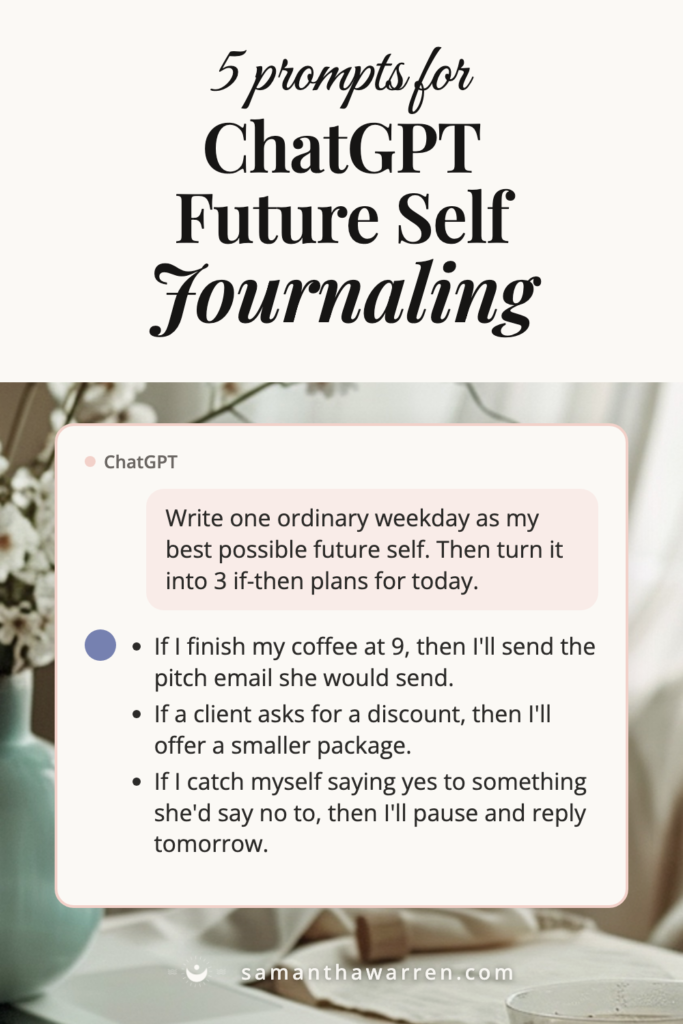
For a long time, my future self felt like a stranger to me. I’m a firm believer in future self work (showing up as your next-level self before all the evidence arrives), and still, the woman I pictured felt like she came straight off a Pinterest board. She was pretty and a little blurry, a fantasy version of me who didn’t really exist anywhere outside my vision board.
So I started using ChatGPT to make her real. This post gives you the five future self journaling prompts I use: one shows you a full, ordinary day in your future self’s life (where she wakes up, what she eats for breakfast, what’s on her calendar and what she says no to), and the rest turn that dream day into a to-do list you can act on today. I’ll also show you the one step the viral version of this prompt skips, because the research says skipping it can work against you.
If you’d rather watch than read, the full video is right here:
Why your future self feels like a stranger
A psychologist named Hal Hershfield studies how we think about our future selves, and his work explains why she feels so far away. In one study his team scanned people’s brains while they thought about themselves now, themselves 10 years from now and other people. For a lot of people, thinking about their future self looked more like thinking about a different person (Ersner-Hershfield, Wimmer & Knutson, 2009).
You’ve probably felt this. It’s the night you leave the dishes in the sink for tomorrow, like the tomorrow version of you is a roommate you barely know and she can deal with it. And in that line of research, the people whose future self felt more like a stranger were more likely to take the smaller reward right now instead of waiting for the bigger one later (Ersner-Hershfield et al., 2009).
That matters because our big, beautiful goals are usually long-term things, and instant gratification is exactly what trips us up. If future you feels like a totally different person, it’s really easy to keep choosing what current you wants today instead of what she would choose, and every one of those choices widens the gap between where you are and where you want to be.
So the first prompt below is designed to make her vivid, someone you actually feel connected to, so it gets easier to make decisions as her. You get to see her on a regular Tuesday, which is so much more powerful than an aspirational picture you glance at on your vision board once a month.
What the viral future self prompt is missing
You’ve probably seen the viral version of this: describe your dream life, ask ChatGPT for a story about a day in your future self’s life, then ask it for a schedule. It went viral for a reason, and the first two prompts below look a lot like it. Mine changes at the third prompt, right after the story.
A psychologist named Gabriele Oettingen has studied dreaming about the future for years, and she found something surprising. When people only daydream about the dream outcome, their motivation to go get it can actually drop. In her experiments, people who spent time on a happy fantasy felt less energized afterward (Kappes & Oettingen, 2011), which goes against a lot of the “visualize your dream life every day” advice we hear.
Here’s what that looks like in real life. Say you spend Sunday night visualizing your dream life, and it feels so good that you’re relaxed Monday morning, like it already happened. Your brain got a little taste of the win, so it stopped pushing you toward it in the 3D. What worked better in her research was pairing the dream with the obstacles that could get in your way, which is exactly what prompt 3 does. You keep the dreamy part we’re all excited about, and you add one honest question after it.
Prefer pen and paper? My future self journaling prompts come with a free printable, so you can do this without ChatGPT.
Before you start: think of AI as a mirror
Quick reminder before the prompts. I like to think of AI as a mirror, and it doesn’t know you better than you know yourself. It takes what you give it and hands back something you can use, so the better your input, the better the output.
Always remember that whatever these tools give you is one perspective, and that’s it. The results aren’t the law, so use your own discernment with what comes back and keep what feels true to you.
The 5 ChatGPT prompts for future self journaling
Copy and paste these into ChatGPT one at a time, in order, in the same chat. Fill in the parts in brackets with your own details, as specifically as you can.
1) Tell it about the real you
I want to do future self journaling with you. First, here’s my life right now: [where you live, your work, your typical week, how many hours you actually have, your energy, and what feels heavy]. Here’s what I’m calling in over the next one to three years: [your desires, as specific as you can]. Before you write anything, ask me five clarifying questions one at a time, and wait for my answer before asking the next one.
If you’ve read my other posts, you know I always put the clarifying questions in my prompts. When you skip them, ChatGPT is much more likely to write a generic dream life for a generic girl, and you won’t feel anything reading it because it isn’t personalized to you. The questions let it get to know you the same way a good friend would before giving you advice.
2) Her best possible day
Now write a story of one ordinary weekday in my life as my best possible future self, one where everything I describe has gone as well as it possibly could. Write it in first person present tense, like a diary entry. Include sensory details: where I wake up, what I see, what I eat, what’s on my calendar, who I talk to, what I say no to, how my business runs, and how I feel at the end of the day. Use what I told you about my real life so it sounds like me.
I worded this one on purpose. Writing about your life as if everything went as well as it possibly could is a well-studied exercise called the Best Possible Self exercise, and in the first big study on it, students who wrote this way for 20 minutes a day, four days in a row, were in a better mood weeks later (King, 2001). When researchers later looked at about 30 of these studies together, the exercise reliably gave people a small to medium lift in optimism and positive feelings (Carrillo et al., 2019). “Ordinary weekday” keeps the day believable, and “best possible” keeps it in the version of the exercise that actually gave people that lift (a cute, average day where you answer emails and run to Target doesn’t do the same thing).
3) The obstacle (the step the viral version skips)
Compare that day to my real life right now. Where does my current life contradict this the most? What’s the one obstacle inside me, like a habit, a belief, or a decision I keep making, that’s most likely to get in the way? Be honest and specific, and ask me a follow-up question if you need to.
This is what I call future self work with evidence. At some point you have to ask yourself how you close the gap between where you are now and who she is, and these are the questions I keep coming back to:
- What would she stop tolerating?
- What would she say no to?
- What does her calendar look like?
- What does her pricing say about her?
Once you start answering those, your dream life stops being a cute Pinterest board and starts showing up in the decisions you make today. And being self-aware about your obstacles is empowering, because you know exactly what you’re up against and what to do next to clear it.
4) Turn her into today’s plan
Based on her day and the obstacle you found, give me a plan for today that fits my real calendar and energy. Three actions max, each one under 30 minutes. Write each action as an if-then plan. Like: if it’s 9 AM and I finish my coffee, then I’ll send the pitch email she would send. Add one if-then plan for the obstacle. Like: if I catch myself saying yes to something she’d say no to, then I’ll [fill in the blank].
This is the part that made the viral version go viral, the to-do list, except now it fits your actual life. You’re reverse engineering your dream life into manageable chunks, and even if you did all three actions every day, that’s only an hour and a half of personal growth work.
An if-then plan names the exact moment you’ll do something, kind of like cause and effect: “If this happens, then I’ll do that.” For example, “If it’s Sunday at 7 PM, then I’ll put three money tasks on my calendar,” or “If a client asks for a discount, then I’ll say my price stays the same and offer a smaller package.” There’s a lot of research behind this one, including a review of 94 studies that found that people who wrote their goals as if-then plans were much more likely to follow through than people who only set the goal (Gollwitzer & Sheeran, 2006).
It works by removing friction. When the trigger shows up, your brain already knows the next action, so you skip the decision fatigue of figuring out what to do (or whether you’re going to do it) in the moment, because it’s already decided.
5) The weekly check-in (once a week)
Here’s what I actually did this week: [paste what you did]. Update my future self’s day if anything about her has changed. Tell me where I acted like her and where I didn’t, and give me three if-then plans for the next week.
This one uses ChatGPT as an accountability partner, and it’s what turns this prompt stack (as I like to call it) into a system you can repeat. You start with a desire, look at the evidence, make a decision based on that evidence, take action and get feedback, and then the feedback shapes the next version of you and the next round of the loop. It’s especially helpful in the messy middle, which is where so many of us get in our own way.
How to use these prompts
Here’s how I’d set it up if I were starting today:
- 1) Do prompts 1 through 4 once. It’ll take you maybe 20 minutes, and you can take longer if you want.
- 2) Save the story somewhere you’ll actually look at it, like your notes app or a ChatGPT project.
- 3) Reread it every morning with your coffee (or whenever works for you). It takes about five minutes, and little habits add up to big results.
- 4) Send prompt 5 every Sunday.
And write the way you talk. I usually use voice dictation instead of typing, because I get lazy about typing… LOL. It helps, too, because the response mirrors your own language, and when your future self sounds like you, she feels a lot more real.
The goal is to stay out of an airy-fairy manifestation world where you’re visualizing every day and never moving the needle. The story gives you the feeling, and the obstacle and the if-then plans give you the movement.
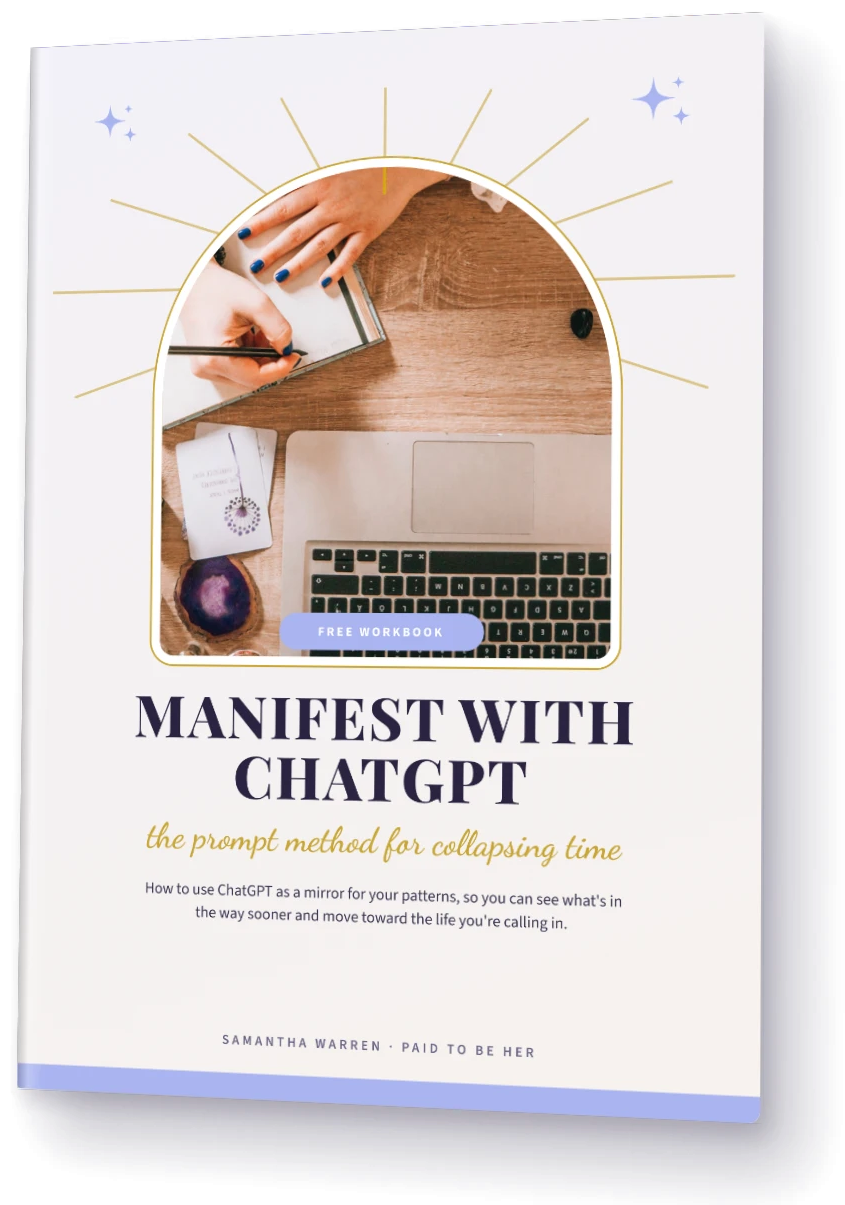
Get the free Manifest with ChatGPT workbook
These five prompts work as one loop: see her, name what’s in the way, act, then check in. If you want to go deeper on every part of that loop, my free workbook, Manifest with ChatGPT, is the prompt method I use for collapsing time, and it picks up right where this post leaves off.
Here’s what’s inside:
- The setup prompt that tells ChatGPT who you are and what you’re calling in, so it stops handing you generic answers.
- My 5-part prompt formula, so you can write your own prompts that sound like you.
- 6 prompt stacks for desire, belief, evidence, identity leaks, behavior and feedback. The evidence and identity leaks stacks take the obstacle step from prompt 3 even further (an identity leak is a little place where you’re still acting like the old you).
- A follow-up toolkit for going deeper when ChatGPT’s first answer isn’t quite it.
- Notes pages so your answers live in one place.
Pop your email in below and it’s yours.
FAQ
1) Can you use ChatGPT for future self journaling?
Yes, and it works best when you give ChatGPT the real details of your life and what you’re calling in. It asks you clarifying questions, and then it writes a first-person diary entry of one ordinary day as your best possible future self. From there, you can ask it to name what’s in your way and turn the day into a small plan for today.
2) What should I write in a future self journal?
Write about one ordinary weekday in your future life in first person present tense, with sensory details: where you wake up, what you see and eat, what’s on your calendar, who you talk to, what you say no to, how your business runs and how you feel at the end of the day. Then write down the one obstacle most likely to get in the way.
3) Can visualizing your dream life make you less motivated?
It can if that’s the only thing you do. Gabriele Oettingen’s research found that people who spent time on a happy fantasy felt less energized afterward. Pairing the dream with the obstacle that could get in the way, plus a plan for it, worked better in her research.
4) What is an if-then plan?
An if-then plan names the exact moment you’ll take an action: “If it’s Sunday at 7 PM, then I’ll put three money tasks on my calendar.” A review of 94 studies found people who wrote goals this way were much more likely to follow through than people who only set the goal.
5) How long does future self journaling with ChatGPT take?
About 20 minutes the first time for prompts 1 through 4, then about five minutes each morning to reread your story and a few minutes every Sunday for the weekly check-in.
Here’s what I want you to take away…
Your future self starts to feel real when you can see her on a normal Tuesday and then make decisions today based on what she would do. So write her best day, name what’s in the way, and give yourself if-then plans you can actually follow through on. Then do it again the next day, and the next day, until you get the result you want, because we’re relentless about our goals over here. You get to become the woman who already makes her choices, one ordinary Tuesday at a time.
Tell me what your future self is doing
I’d love to know what your future self is doing that you’re not doing yet. For me, it’s Pilates. I’ve always said I wanted to go and I haven’t tried it yet, but I’m pretty sure my future self is doing Pilates, girl.
DM me on Instagram at @samanthaleewarren and tell me yours, because I love hearing about who you’re becoming. 💙
And if you want to keep that momentum going with ChatGPT and a whole community of women doing the same work, my free 3-day challenge lives inside Paid to Be Her.
Pin me to your favorite Pinterest board!