
At some point, every capable woman has tried to fix her money with a spreadsheet and a pep talk. And if that worked long-term, you wouldn’t be here.
Because the pattern usually isn’t “I don’t know what to do.” The pattern is: you do know… and something in you still self-sabotages, avoids, over-spends, under-earns, or freezes.
I call that an identity leak: a repeated money pattern that quietly drains the parts of you that actually create freedom: self-trust, options, calm, and clean decision-making. And yes, it can look like a budgeting problem. But it behaves like an identity problem.
I’m Sam, full-time digital nomad, entrepreneur, marketing consultant, and someone who’s had to build my self-concept the unsexy way: through decisions, boundaries, and responsibility.
Freedom isn’t a location or an aesthetic. Freedom is the result of trusting yourself enough to choose intentionally, even when it disappoints people. Money is one of the loudest places that lesson shows up.
Quick note: This post is educational, not financial or mental health advice. If you’re dealing with housing insecurity, coercive financial control, or any kind of crisis, please seek local support. Some money patterns are personal & some are structural. Both are real.
What an “Identity Leak” Actually Is
An identity leak is any repeated money pattern that drains one (or more) of these four assets:
- Agency (choice, control, options)
- Integrity (alignment, self-respect, doing what you said you’d do)
- Belonging (healthy connection, reciprocity, not buying your place in the room)
- Safety (nervous system calm, predictability, stability)
Here’s the shift:
You don’t fix money by becoming a “better” person. You fix money by finding what’s leaking and repairing it with systems + standards + self-trust.
Because a budget can track numbers. It can’t repair the part of you that doesn’t trust herself to face reality.
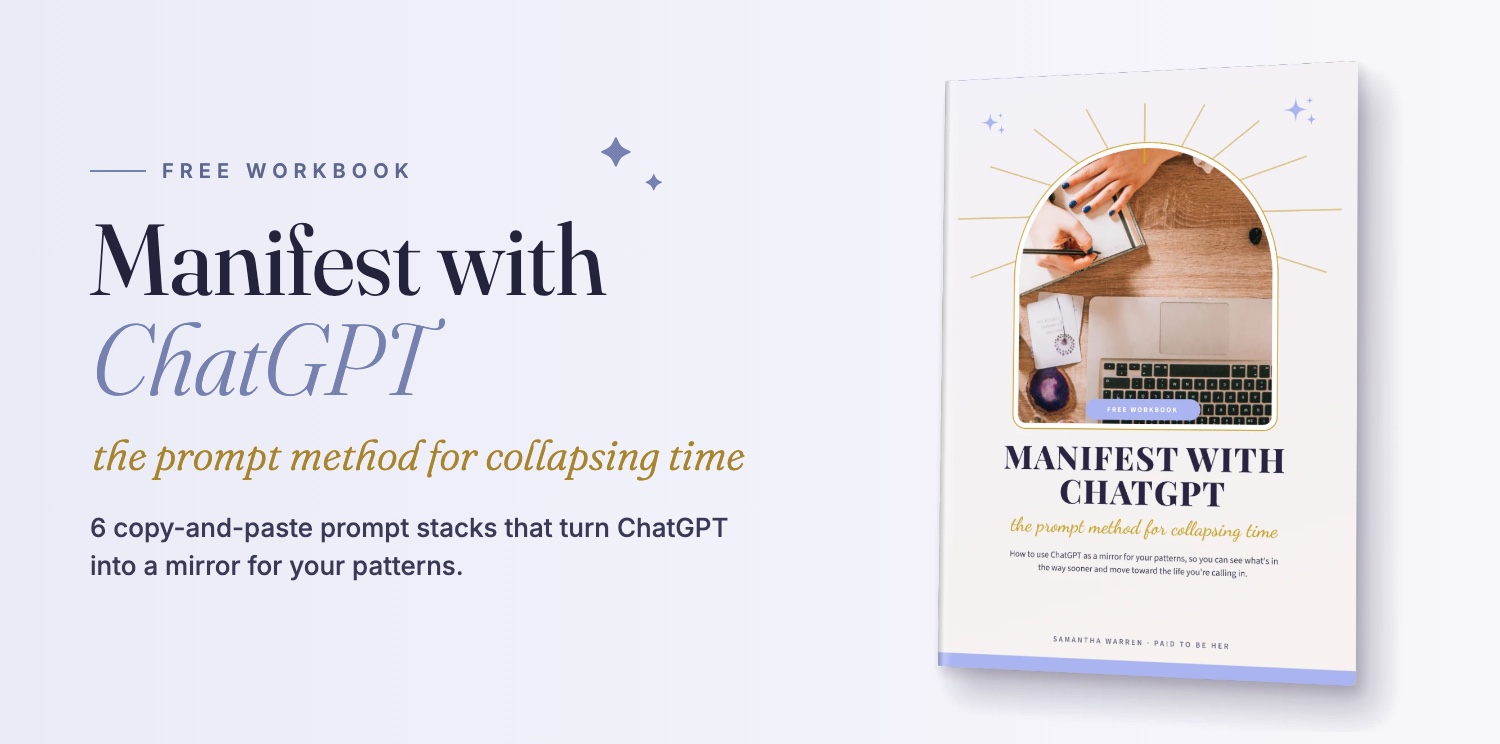
If You’re Manifesting… But Still Feel Stuck, Start Here.
My free workbook, Manifest with ChatGPT, is the exact prompt method I use to collapse time: 6 copy-and-paste prompt stacks that turn ChatGPT into a mirror for your patterns, so you can see what’s in the way sooner and actually move toward what you’re calling in.
You can use these prompts for any area of your life: relationships, direction, creativity, confidence…
And yes, many people naturally uncover powerful insights around work, money, and self-worth along the way.
This isn’t about forcing outcomes or waiting for signs.
It’s about having better conversations with yourself with ChatGPT as a neutral, clarifying mirror.
The 4 Types of Identity Leaks (And What They Look Like in Real Life)
1) Agency leaks: “I feel trapped”
Agency leaks show up when money feels like a cage.
Signs you’re leaking agency:
- You feel boxed in by bills, debt, family expectations, or lifestyle overhead
- You delay decisions because you’re terrified of choosing “wrong”
- You stay in a job/relationship/situation because leaving feels financially impossible
- You keep saying, “Once I have more money, then I’ll…”
What’s really happening:
You’re not just short on cash… you’re short on options. And options are the foundation of freedom.
Repair plan (start here):
- Lower fixed costs before you try to “earn more” (fixed costs are the fastest way to lose agency)
- Build a small buffer (even $500–$1,000 changes your nervous system)
- Create one “escape route” skill (something you can monetize quickly if needed)
Agency is built. Not wished into existence.
2) Integrity leaks: “I don’t trust myself”
This is the most common one I see in high-achieving women: you’re competent everywhere… except you keep breaking promises to yourself around money.
Signs you’re leaking integrity:
- You hide purchases, minimize numbers, or “forget” subscriptions
- You set a plan and then blow it up the moment you feel stressed
- You feel like you can’t rely on yourself financially
- You’re always “starting over Monday”
What’s really happening:
Every time you avoid, over-spend, or abandon your plan, your self-trust takes a hit. Not because you’re weak, because your brain learns: my word doesn’t mean much.
Repair plan (start here):
- Choose one promise you can keep weekly (not daily)
- Reduce the number of financial decisions you need to make
- Track “proof of self-trust” (more on this below)
Self-trust isn’t a vibe. It’s evidence.
3) Belonging leaks: “I’m spending to be liked (or to keep up)”
Belonging leaks are sneaky because they pretend to be “fun spending” or “treating yourself.” But underneath is often social pressure, comparison, or fear of being judged.
Signs you’re leaking belonging:
- You overspend around certain friends/family
- You feel anxious showing up “without looking successful”
- You say yes to trips/events/gifts you can’t afford
- You have money resentment in relationships
What’s really happening:
Some spending is an attempt to regulate social safety:
“I belong.” “I’m not behind.” “No one will leave.” “I’m impressive enough.”
Social media doesn’t help because it feeds you a steady stream of “reference lifestyles” that make normal life look like failure.
Repair plan (start here):
- Audit the environments that trigger spending (certain people, places, apps)
- Practice saying: “That’s not in my budget right now… have fun though”
- Build belonging that doesn’t require performance (community > consumption)
You should never have to buy your seat at the table.
4) Safety leaks: “Even with money, I don’t feel secure”
Safety leaks are about your nervous system, not your math.
Signs you’re leaking safety:
- Checking your bank app spikes anxiety
- You avoid bills until it’s urgent (then panic-pay)
- You can’t relax even with savings
- You ruminate about worst-case scenarios
What’s really happening:
Money stress activates threat systems in the body. When you’re in that state, you don’t make calibrated decisions… you default to habit: freeze, avoid, people-please, or impulsively relieve the pressure.
Repair plan (start here):
- Simplify your finances (less complexity = more calm)
- Create predictable touchpoints (a weekly “money date”)
- Stabilize basics before optimizing (budgeting is hard when you’re dysregulated)
Calm is a form of power. Especially with money.

💸 Ready to stop leaking money through old patterns?
If this is hitting home, I created a 7-day reset called Booked, Paid & Unbothered where we do this work together using guided ChatGPT prompts.
Inside, we explore your money identity, uncover the deeper patterns shaping your decisions, and start rebuilding self-trust, clarity, and momentum from a more grounded place.
Why Scarcity Makes You Worse With Money (Even If You’re Smart)
This part matters, because a lot of “financial advice” is secretly moral advice.
When money is tight (or even when it feels tight) your brain goes into scarcity mode. Scarcity creates tunneling: your focus narrows to what’s urgent and steals cognitive bandwidth from what’s important.
That’s why smart women:
- ignore admin tasks (because it’s mentally expensive)
- choose short-term relief over long-term benefit
- make impulsive trade-offs they later regret
- procrastinate decisions that require calm thinking
So if you’ve ever thought, “Why am I like this?” you might not be “like this.”
You might be operating under a predictable cognitive constraint.
And the solution isn’t shame. It’s bandwidth-first systems.
The Money Shame Cycle (a.k.a. The “Don’t Look at the Bank App” Problem)
Let’s name the loop because naming it gives you leverage.
- Financial discomfort triggers shame/anxiety
- Shame triggers avoidance (not checking, ignoring bills)
- Avoidance increases uncertainty
- Uncertainty increases anxiety
- Anxiety looks for relief (denial, scrolling, impulsive spending, freezing)
- Cycle repeats and reinforces identity: “I’m irresponsible”
That’s the identity leak: not just money leaving your account… self-trust leaking every time you avoid reality.
The goal isn’t to “feel confident” before you look.
The goal is to look until it stops feeling like a threat.
When Money Becomes the Scoreboard (The Self-Worth Trap)
One of the most corrosive identity leaks is when money becomes the measurement of your value.
It shows up as:
- “If I earn more, I’ll finally feel safe.”
- “If I’m not further ahead, I’m behind in life.”
- “If I’m not financially perfect, I’m a failure.”
Here’s the grounded truth: money is a tool (and yes, it matters) but self-worth tied to money creates unstable emotional outcomes, because money is inherently variable. Expenses happen. Income fluctuates. Life lifetimes.
I’ve been self-employed for about five years. And entrepreneurship has taught me this the hard way: money is not about hustle. It’s about decision-making under uncertainty: pricing confidently, saying no to misaligned opportunities, letting things compound, and building systems that reduce emotional labor.
When your worth is attached to the number, every fluctuation becomes a threat.
When your worth is attached to your standards, the number becomes data.
Do a “Find the Leak” Diagnostic (Fast)
Read these and pick the strongest “yes.”
Agency leak:
- “I feel trapped by bills/debt/obligations.”
- “I avoid decisions because I’m afraid of choosing wrong.”
Integrity leak:
- “I keep breaking promises to myself about spending.”
- “I don’t trust myself with money.”
Belonging leak:
- “I overspend to keep up / to be liked.”
- “Money tension is damaging my relationships.”
Safety leak:
- “Money thoughts spike my anxiety.”
- “Even with savings, I don’t feel secure.”
Now the important part: you don’t fix all four at once.
You fix the biggest leak first, and the rest gets easier.
How to Do an Identity Audit (10 Minutes, No Drama)
Open your last 30 days of transactions (bank + credit card). No spiraling. We’re collecting data.
Step 1: Pick your top 3 values
Examples:
- Freedom
- Peace
- Health
- Growth
- Creativity
- Family
- Excellence
Step 2: Assign one money behavior to each value
Make it measurable.
- Freedom → lower fixed costs + build emergency fund
- Peace → automate bills + simplify accounts
- Health → groceries you actually cook + movement you’ll do consistently
Step 3: Compare values to spending
Ask:
- Where did my spending prove my values?
- Where did my spending contradict my values?
- What category is screaming “identity leak”?
This turns “alignment” from a concept into a mirror.
The Aligned Decision Filter (Before Your Next Big Money Choice)
Use this before enrolling in the course, booking the trip, quitting the job, moving cities, upgrading your lifestyle, whatever your version is.
The filter:
- Does this decision increase my agency or decrease it?
- Will I respect this decision in 30 days? (integrity test)
- Am I doing this for belonging or for alignment?
- Will this create safety or just temporary relief?
If you can’t answer clearly, pause. Confusion is often your signal that you’re about to buy emotional relief.
Alignment isn’t a feeling. It’s a decision repeated over time.
The “Bandwidth First” Plan (For When You’re Stressed, Busy, or Over It)
If you’re in a season of high stress, unstable income, burnout, heartbreak, grief (anything that reduces your capacity) do not try to build a “perfect” budget.
Build a low-bandwidth system that keeps you stable.
This week’s plan:
Automate minimums
- Minimum debt payments
- Minimum savings (even tiny)
- Bills on autopay where possible
Kill complexity
- One checking account
- One savings account
- One “bills” category (or separate bills account if needed)
Set a weekly money date (20 minutes)
- Same day/time
- Same three numbers:
- Checking balance
- Credit card balance
- Next due bill(s)
Add friction to your biggest leak
- Unfollow the triggers
- Remove saved cards
- Cancel one subscription on “cancellation day”
Stability beats sophistication. Every time.
Income Volatility: When It’s Not Your Discipline, It’s the Wave
A quick word for my freelancers, creatives, commission-based earners, gig workers, and entrepreneurs:
Sometimes the leak isn’t spending. It’s income volatility.
Volatility creates hypervigilance. Planning becomes harder even when you earn “enough” annually because your brain is constantly trying to predict the next dip.
What helps:
- Build a “buffer month” (gradually)
- Base your budget on your low month, not your best month
- Create a variable expense cap (so your lifestyle doesn’t whiplash)
Having more freedom often requires more structure. Nomad life drilled this into me: freedom without self-trust feels like anxiety, and structure becomes your anchor.
When It’s Not “Mindset” It’s Fraud, Exploitation, or System Design
Some “identity leaks” aren’t internal patterns. They’re violations, manipulative systems, or structural realities.
1) Defaults are designed to drain you
Subscriptions, one-click buy buttons, auto-renewals… these are behavioral design choices built on friction (easy to buy, annoying to cancel).
Fix: Monthly recurring-charge purge. Put it on your calendar. Make it a ritual.
2) Scams and identity theft are emotional, not just financial
Financial fraud often creates shame, isolation, hypervigilance, and a real sense of violation. If this happened to you, you’re not “stupid.” You were targeted.
Basics to consider (if you’re in the USA):
- Freeze your credit
- Turn on multi-factor authentication
- Use a password manager
- Check credit reports regularly
3) Structural leaks exist
Pay gaps, caregiving interruptions, healthcare and childcare costs, discrimination… these aren’t solved by “positive thinking.”
You can acknowledge structural reality and reclaim agency inside it by building skills, negotiating, protecting your bandwidth, and making decisions that widen options over time.
Both can be true.
Where Manifestation Fits (Without the Delusion)
I believe in manifestation. I don’t believe in delusion.
Manifestation, as I practice it, is self-trust in motion:
- rooted in self-honesty
- paired with aligned action
- sustained through emotional responsibility
- allergic to avoidance disguised as “faith”
And I’ll say the line I live by (because it stays true in every country, every income level, every era of your life):
You cannot manifest a life you do not trust yourself to hold.
If money triggers you, manifestation isn’t “think richer thoughts.” It’s:
- face the numbers
- repair self-trust
- make clean decisions
- build systems that support the life you want
That’s the grounded version. And it works.
FAQ
1) What does “money identity” mean?
Your money identity is the story (often unconscious) you believe about what money says about you: your safety, worth, competence, power, and belonging. If the story is shaky, your behaviors will be shaky too.
2) How do I stop avoiding my finances when I feel ashamed?
Lower the emotional stakes and increase repetition. Set a 20-minute weekly money date, look at only a few numbers, and focus on building evidence of self-trust. Shame decreases when your nervous system learns, “I can face this and survive it.”
3) Can budgeting still help if this is an “identity leak” problem?
Yes, but budgeting works best as a supporting system, not the main event. If you don’t repair the leak (agency, integrity, belonging, or safety), you’ll keep finding ways around the budget when life gets real.
4) I make good money, so why am I still stressed about it?
Because safety isn’t only math. If you grew up with instability, experienced betrayal, or lived in chronic stress, your body may still interpret uncertainty as threat. Build safety through simplicity, buffers, and predictable money rituals, not just higher income.
Fix the Leak, Not Your Personality
If you’ve been treating your money like a discipline problem, I want you to try a new frame:
Your recurring money pattern isn’t proof that you’re broken.
It’s proof that something is leaking: agency, integrity, belonging, or safety.
Fix that, and the tactics finally stick.
And if you want help integrating manifestation with real-world clarity (the kind that actually changes outcomes), I made a free resource for you:
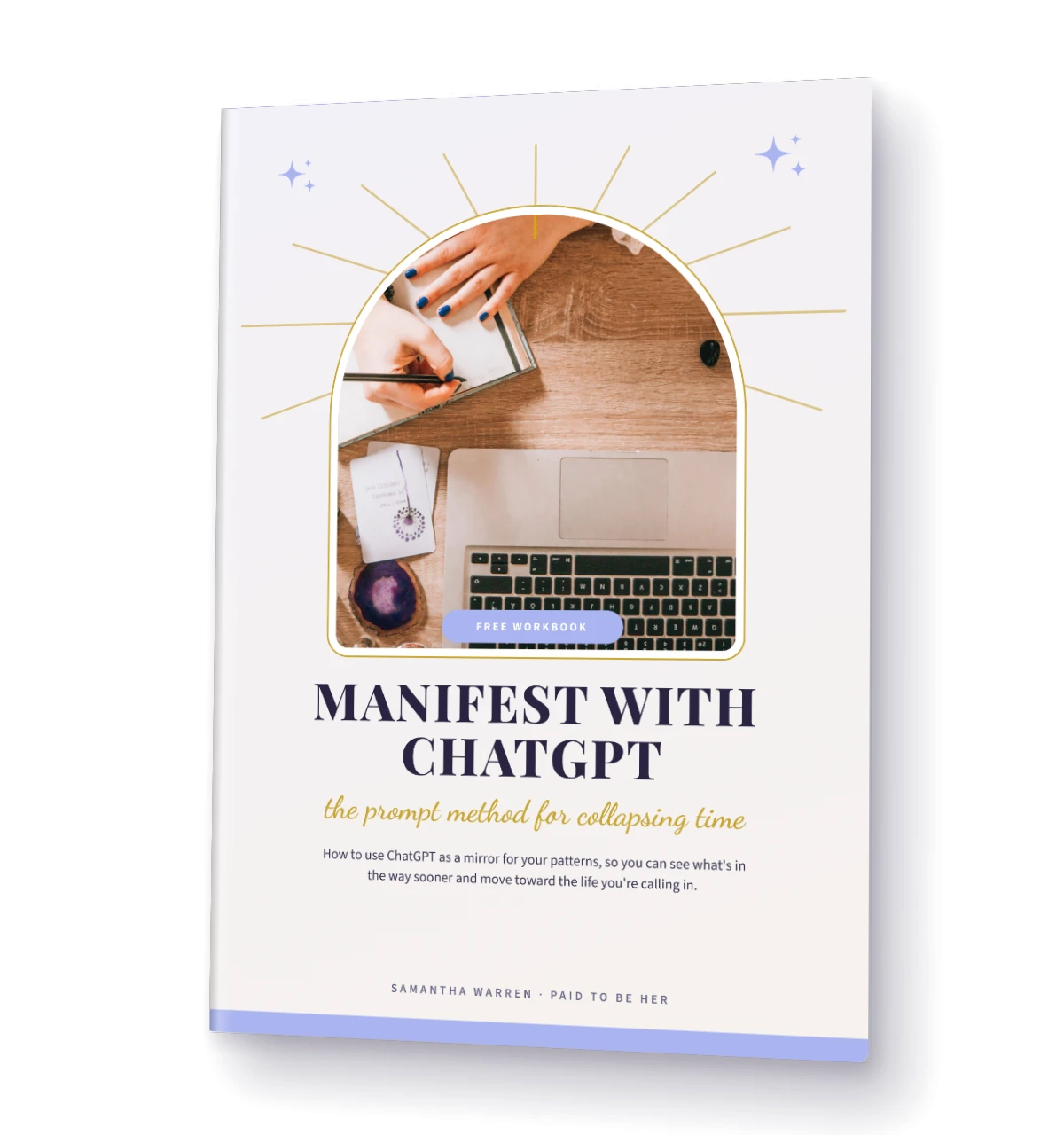
Free workbook: Manifest with ChatGPT. It’s my prompt method for collapsing time: 6 copy-and-paste prompt stacks that help you get specific about what you want, catch the identity leaks costing you money, time or energy, and turn it all into small actions on your real calendar.
Gentle reminder: you don’t need to become a new person.
You need to become the kind of woman who keeps her word to herself, especially when it’s uncomfortable.
Pin Me to Your Favorite Pinterest Board!