There’s a version of you who says,
“I can’t afford it.”
And there’s a version of you who says,
“I’m investing in me.”
The difference between those two statements is not income.
It’s self-trust.
And before you assume this is another “money mindset” article, let’s ground this in something real: your brain under stress behaves differently. Your decisions under perceived scarcity are not neutral. They are neurologically and psychologically shaped.
So if you’ve ever felt capable, intelligent, and ambitious… yet weirdly small or reactive around money… you’re not broken.
You’re likely running an old script.
Let’s talk about what that actually means.
You’re Not “Bad With Money.” You’re Running a Money Script.
Financial psychologists describe money scripts as unconscious beliefs about money formed early in life, often shaped by family dynamics, instability, modeling, and emotional experiences.
Research identifying dominant money script patterns commonly groups them into four types:
- Avoidance – Money feels stressful, so you avoid looking at it.
- Worship – More money will fix how I feel.
- Status – Spending signals success and identity.
- Vigilance – Hyper-control equals safety.
For me, avoidance and worship are the closest of the four. Avoidance is the urge to look away from the numbers, and worship is the belief that more money will fix how you feel. Naming my patterns gave me something specific to work with, which felt a lot better than a general sense of being “bad with money.”
These scripts are not personality traits. They are adaptive patterns.
If you grew up needing to be capable early…
If safety depended on being responsible…
If mistakes felt dangerous…
Your nervous system may have paired money with survival.
Which means when you say,
“I can’t afford it,”
your brain may not be doing math.
It may be scanning for threat.
If You’re Manifesting… But Still Feel Stuck, Start Here.
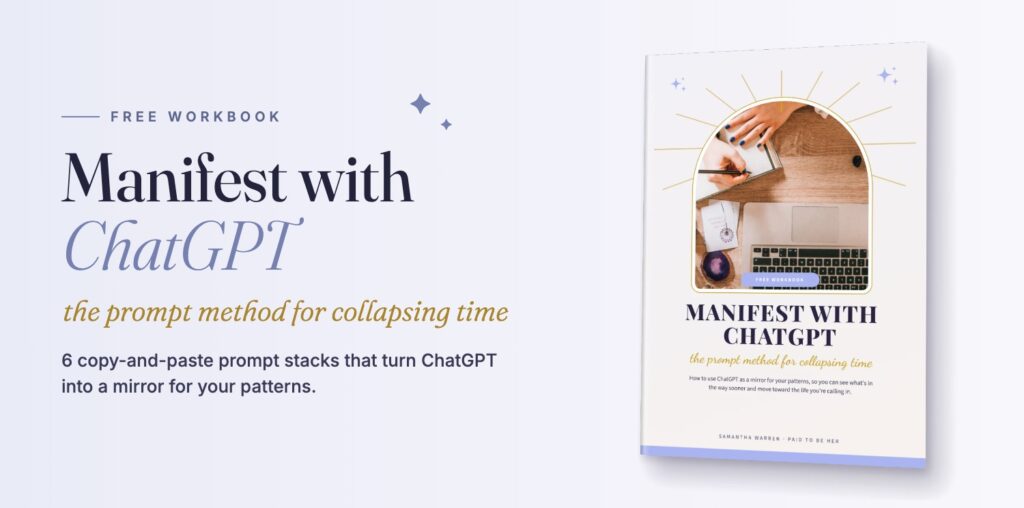
My free workbook, Manifest with ChatGPT, is the exact prompt method I use to collapse time: 6 copy-and-paste prompt stacks that turn ChatGPT into a mirror for your patterns, so you can see what’s in the way sooner and actually move toward what you’re calling in.
You can use these prompts for any area of your life: relationships, direction, creativity, confidence…
And yes, many people naturally uncover powerful insights around work, money, and self-worth along the way.
This isn’t about forcing outcomes or waiting for signs.
It’s about having better conversations with yourself with ChatGPT as a neutral, clarifying mirror.
Scarcity Changes How You Think
Scarcity creates tunnel vision.
That’s why “I can’t afford it” can feel true even when:
- The numbers technically work.
- The investment is reasonable.
- The long-term upside is clear.
Your brain under perceived threat prioritizes loss avoidance over future gain.
This is not weakness. It’s protective wiring.
But protection is not always alignment.
The Real Question Isn’t “Can I Afford It?”
It’s:
Do I trust myself with this decision?
There’s a difference between:
- Financial irresponsibility
- And fear disguised as prudence.
Hyper-independent women often lean toward over-responsibility. You don’t want to make a mistake. You don’t want to depend on anyone. You don’t want to look reckless.
So you hesitate.
You call it discipline.
Sometimes it is.
Sometimes it’s avoidance.
Self-Trust Changes the Frame
When I shifted from “I can’t afford it” to “I’m investing in me,” it wasn’t because I started spending impulsively.
It was because I started asking better questions.
Instead of:
“What if this fails?”
I asked:
“If this expands me, am I willing to back myself?”
That’s a different posture.
It moves from fear-based budgeting to values-based allocation.
And this shift is supported by research in behavioral economics on mental accounting, the way we categorize and frame money decisions.
When money is labeled purely as “expense,” the brain registers loss.
When money is framed as “investment,” it is evaluated against long-term value.
Same dollars. Different narrative. Different emotional response.
Language matters because cognition follows framing.

Ready to Become the Woman Who Invests in Herself?
Rewriting your money script isn’t about reckless spending or forcing confidence.
It’s about becoming the kind of woman who trusts her decisions, sets higher standards, and stops shrinking when opportunities appear.
That’s exactly what we build inside Booked, Paid & Unbothered, the program designed to help you upgrade your money identity, raise your standards, and create income that actually reflects your value.
Because the real shift isn’t just earning more.
It’s becoming the woman who backs herself.
How You Actually Update a Money Script
Not with affirmations.
Not with delusion.
Not with aesthetic budgeting spreadsheets.
With structure and repetition.
Let’s integrate what the research actually supports.
Cognitive Restructuring: Question the Automatic Thought
Cognitive Behavioral Therapy (CBT) consistently shows that identifying and reframing unhelpful automatic thoughts reduces anxiety and improves behavior.
Money trigger:
Unexpected expense.
Program enrollment opportunity.
Price increase.
Automatic thought:
“This is irresponsible.”
Instead of accepting that as truth, you ask:
- What is the evidence?
- What is the cost of not acting?
- Is this fear or data?
AI is particularly effective here… not as a therapist, but as a structured journaling guide. It can walk you through a thought record consistently, reducing emotional reactivity and decision fatigue.
You’re not outsourcing decisions.
You’re externalizing the thinking process.
That builds clarity.
Clarity builds self-trust.
And self-trust is the real currency.
Not income.
Not aesthetics.
Not how calm you look on Instagram.
Self-trust is what allows you to make decisions under uncertainty without spiraling.
Because here’s what I’ve learned:
You don’t actually need to eliminate fear around money.
You need to trust yourself more than you fear the outcome.
Fear Is Loudest When You’ve Had To Be “The Responsible One”
If you were the capable one early…
If you learned that being strong meant handling everything alone…
If mistakes felt expensive emotionally, not just financially…
Of course you hesitate.
Of course you overthink.
Of course you want to be sure.
Independence creates an internal pressure to never misstep. And when you carry that into money decisions, “being smart” can quietly become “never risking.”
But growth requires risk.
Not chaos.
Not recklessness.
Risk.
There is a difference.
And self-trust is what lets you tell them apart.
You’re Not Scared of Spending.
You’re scared of regret.
You’re scared of:
“I should’ve known better.”
“I messed this up.”
“I can’t believe I did that.”
Especially if you pride yourself on discernment.
Especially if you’ve rebuilt your life once already.
Especially if you’ve had to clean up other people’s messes.
So you shrink.
You delay.
You wait.
You research endlessly.
You say, “It’s just not the right time.”
Sometimes it truly isn’t.
But sometimes you’re just trying to avoid the emotional responsibility of choosing.
And choosing is uncomfortable.
Because choosing means owning the outcome.
The Moment I Realized What Was Actually Happening
There was a season where I looked incredibly free on the outside.
Traveling.
Working remotely.
Building my own income.
Making independent decisions.
But internally? I still hesitated with expansion.
Not because I couldn’t afford things.
Because I didn’t fully trust myself if they didn’t go perfectly.
That’s when it clicked.
Freedom without self-trust feels like anxiety.
You can have location freedom and still feel internally restricted.
You can earn well and still operate from scarcity.
Because scarcity isn’t always about money.
It’s about how safe you feel inside your own decisions.
“Investing in Me” Is an Identity Shift
The shift didn’t happen when I made more money.
It happened when I decided:
Even if this doesn’t work the way I expect,
I trust myself to handle it.
That’s the real investment.
Not the course.
Not the trip.
Not the strategy.
The investment is backing yourself.
That’s why manifestation without responsibility doesn’t work.
You cannot manifest a life you don’t trust yourself to hold.
Alignment is not a feeling.
It’s a decision repeated over time.
And sometimes alignment looks like restraint.
Sometimes it looks like bold action.
Self-trust is the filter.
Structure Is Not Restriction. It’s Self-Respect.
When I became nomadic, I learned quickly:
More freedom requires more structure.
If you remove external anchors, you must build internal ones.
The same applies to money.
If you want to feel calm with your finances, you need systems.
Not dramatic overhauls.
Not obsessive tracking.
Systems.
For me that looked like:
Weekly money check-ins instead of emotional spirals.
Automated transfers instead of last-minute guilt.
Clear categories tied to my values, not my fears.
I stopped asking:
“Do I feel safe?”
And started asking:
“Am I building safety?”
That shift changes everything.
Because safety is not something you wait to feel.
It’s something you design.
The Subtle Difference Between Protecting and Shrinking
Here’s where discernment matters.
Not every “I can’t afford it” is fear.
Sometimes it’s wisdom.
Sometimes it’s timing.
Sometimes it’s knowing your current capacity.
Self-trust means you don’t shame yourself either way.
But you do tell the truth.
Are you protecting your long-term stability?
Or are you shrinking to avoid discomfort?
If you sit quietly with that question, you’ll know.
Glow-Ups Are Internal First
The real glow-up is not increasing your income.
It’s increasing your capacity.
Capacity to:
- Make bigger decisions.
- Hold uncertainty.
- Sit with discomfort.
- Recover from mistakes.
- Trust your judgment.
Villain era isn’t about being ruthless.
It’s about no longer over-explaining your decisions.
It’s about choosing sustainability over chaos.
Alignment over approval.
Long-term respect over short-term validation.
When you say,
“I’m investing in me,”
You’re not flexing.
You’re committing.
ChatGPT prompts to find your money blocks and rewrite your script
These are the prompts I’d use to put everything above into practice. Paste them into ChatGPT (or Claude) one at a time, and answer as honestly as you can.
1. Find your money script
Act as a supportive money coach who knows the four money scripts: avoidance, worship, status and vigilance. Ask me 6 questions, one at a time, about how money was handled in my family growing up, how I feel when I check my bank account, and what I do when an unexpected expense shows up. Then tell me which one or two scripts I seem to be running and how they show up in my day-to-day decisions.
2. Find your money blocks
Help me find my money blocks. Ask me to finish these sentences honestly: "Rich people are...", "If I made double what I make now, I'd worry that...", "Charging more would mean...", "I can't afford it because...". Then point out the beliefs hiding in my answers and which one is most likely holding back my income.
3. The ChatGPT thought record for money fear
I want to work through a money fear using a CBT-style thought record. The situation: [what happened, e.g. an expense, a price increase, a program I want to join]. My automatic thought: [what your brain said]. Ask me: What is the evidence for this thought? What is the evidence against it? What is the cost of not acting? Is this fear or data? Then help me write a more balanced thought and one small action I can take today.
4. Rewrite the script
Based on what we found, write a new money script for me in first person, present tense: 5 sentences that describe how the self-trusting version of me thinks and decides about money. Keep it believable for where I am right now, not where I want to be in ten years.
Self-trust money mantras
- I make money decisions from data and self-trust.
- I can hold uncertainty and still choose clearly.
- Investing in myself is a decision I’m allowed to make.
- I build safety with systems, one small step at a time.
- I can recover from a money mistake, so I don’t need to avoid every risk.
Journal prompts to go with them
- When did I last say “I can’t afford it,” and was it fear or data?
- What would the self-trusting version of me do with my next unexpected expense?
- What’s one money system I could set up this week so I don’t have to rely on willpower?
If You Want to Start Updating Your Script
Start small.
Notice the next time you say,
“I can’t afford it.”
Pause.
Ask:
Is this data?
Or is this fear?
What would the self-trusting version of me do here?
Then take one aligned step.
Maybe that’s enrolling.
Maybe that’s waiting.
Maybe that’s transferring $10 automatically every week.
Self-trust is built in micro-decisions.
Not declarations.
You’re Not Behind.
Manifestation is not about getting everything you want by wanting it harder.
It’s about building the self-trust to choose intentionally, especially when your old patterns want to negotiate, perform, shrink, or settle.
Clarity.
Alignment.
Action.
Repeated until your life reflects your standards.
If you’ve realized that “I can’t afford it” is sometimes fear…
If you’re ready to move from reacting to money to responding with intention…
If you want something practical that helps you actually apply this…
I made something for you.
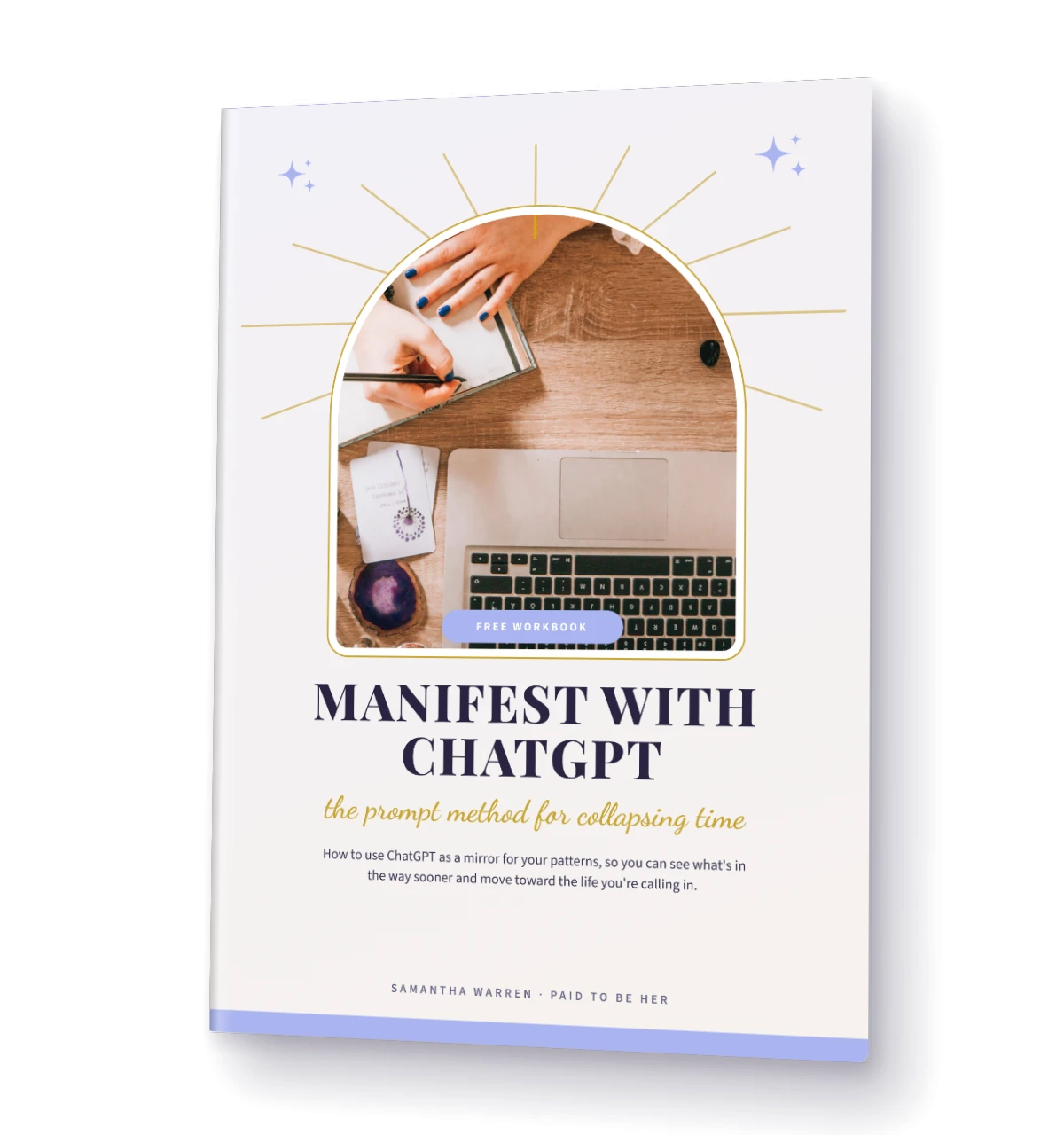
✨ Free Workbook: Manifest with ChatGPT
This isn’t delusional journaling.
It’s a grounded prompt method you can use with ChatGPT to:
- Get crystal clear on what you actually want
- Catch the identity leaks that quietly pull you off course
- Plan the week your future self would actually live, one small action at a time
It’s designed to help you move from “thinking about it”
to becoming unavailable for the life you’ve outgrown.
Because clarity builds self-trust.
And self-trust builds freedom.
Pin Me to Your Favorite Pinterest Board!