
Being good at what you do is exhausting.
I mean the kind that shows up when clients love you, results are happening, your calendar is full, and somehow you still feel one inconvenient week away from resenting the business you built.
I’ve been there and done that…
From my 5+ years in business, I learned that a lot of entrepreneurs have a founder dependency problem. Your business relies on you to answer questions, make decisions, review work, and solve problems every day.
And because you’re capable, it’s easy to confuse that constant personal involvement with the actual reason clients get results.
I know that pattern because I built it. I scaled a marketing agency to 20+ clients by saying yes too often, customizing too much, and becoming the point of contact for basically everything. It looked successful from the outside. Internally, it was ceiling-based.
That realization led me to rebuild my business in a way that depended less on my personal time and availability… and that’s what I now teach through Paid to Be Her.
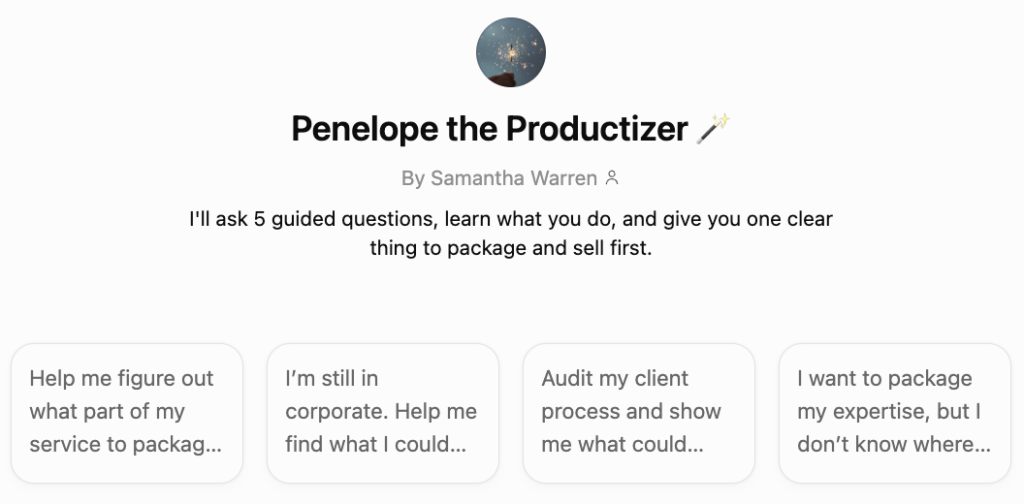
If you want help answering that question for your own business, start with Penelope, the Productizer, my free AI-guided 5-question audit that identifies one thing you can package into a real offer without trading more time for money.
It’s simple, sharp, and gives you an actual starting point, not just more ideas.
Why this matters more than “just make a digital product”
Before we get into the list, let’s clean one thing up.
A productized service is not the same thing as a digital product, and neither of them is a magic “passive income” machine.
- Productized service: a standardized, repeatable service with fixed scope, pricing, and timeline
- Digital product: a lower-delivery offer like a template, guide, or course
- Software/SaaS: a completely different business model with its own complexity
For most women leaving corporate or trying to stop recreating corporate inside their business, the first smart move is not “build a course and disappear.” It’s usually packaging the work you already know gets results into something more defined, transferable, and less dependent on your live improvisation.
Because the real drain is variability, not hours.
It’s:
- unclear scope
- emotional labor
- endless revisions
- constant context switching
- being the human glue holding each client experience together
That’s what we’re fixing.
1. Your intake questions
If you ask every client roughly the same questions before you can do good work, that is not a cute little habit. (It’s so much more exciting than that!) You are stumbling upon the beginning of an asset.
Most experts think their intake process is casual because it lives in voice notes, DMs, Notion docs, or their own head. But if you consistently need the same context to diagnose the problem, you already have a framework.
What this could become
- A diagnostic questionnaire
- A pre-work form
- A mini audit
- A paid assessment offer
Signs it’s packageable
- You ask some version of the same 10–15 questions every time
- The answers help you spot the same patterns quickly
- Clients often say, “No one’s ever asked me that before”
Your value is often not just in the answer. It’s in the sequence of questions that gets to the truth faster.
2. Your audit or review process
If clients hire you and the first thing you do is “take a look” at what’s happening, that review process can likely stand on its own.
This is especially true for marketers, designers, strategists, coaches, consultants, and operators. If you can look at a funnel, a brand, a workflow, a customer journey, or a decision-making pattern and quickly identify what’s off, you have something packageable.
What this could become
- Messaging audit
- Funnel teardown
- Brand review
- Operations audit
- Decision clarity intensive
I built Penelope from this exact logic. The tool came from a real business question: what part of what I already do doesn’t actually need me live, every single time? This is the part of your process where you review a client’s business, identify the problem, and recommend what they should fix first.
3. Your repeated explanations
If you explain the same concept to clients every week, stop calling that “just part of the process.”
It’s a training asset, a.k.a. creating resources and systems you can reuse across multiple clients instead of repeating the same work each time.
What this could become
- Loom library
- client education hub
- onboarding guide
- FAQ document
- mini workshop
And no, this does not make you less valuable. It makes your expertise easier to receive.
A lot of women stay over-involved because their knowledge is still tacit. In organizational terms, tacit knowledge is what you know through experience but haven’t made explicit yet. Productization is often just the process of pulling that knowledge out of your body and putting it into a usable container.
4. Your step-by-step delivery sequence
If your client work follows a pattern, even loosely, you have the bones of a productized service.
This is where a lot of people resist because they think, “But every client is different.” Sure. Every client is different in some ways. That doesn’t mean your process is.
There’s usually a repeatable sequence underneath the custom details:
- assess
- prioritize
- build
- review
- refine
- hand off
What this could become
- A fixed-scope sprint
- A VIP day
- A 2-week implementation package
- A signature service with clear deliverables
The point is not to erase your judgment. It’s to stop making your client pay for your lack of structure.
5. Your decision-making rubric
If clients come to you because you “know what to prioritize,” your product could be a written set of criteria you use to decide what a client should prioritize.
You may be making repeated decisions like:
- If traffic is low, fix visibility before conversion
- If leads are coming in but not closing, fix offer clarity before content volume
- If a brand feels inconsistent, simplify positioning before redesigning visuals
That is gold.
What this could become
- A scoring framework
- A prioritization matrix
- A strategic decision tree
- A planning tool clients can use with or without you
This is also where founder dependency usually hides. People say, “It only works because it’s me,” when what they often mean is, “I haven’t extracted my decision rules.”
6. Your client onboarding
If every new client needs calming down, orienting, reminding, clarifying, and walking through the same expectations, your onboarding is doing too much emotional labor manually.
And yes, emotional labor counts as labor.
A strong onboarding system doesn’t just save time. It reduces ambiguity, which reduces client anxiety, which reduces your over-functioning.
What this could become
- An onboarding portal
- A welcome packet
- A kickoff training
- A pre-recorded expectations walkthrough
- A standardized first-week sequence
What good packaging here does
- sets boundaries sooner
- reduces unnecessary back-and-forth
- protects your energy
- increases perceived professionalism
Calm is a form of power in business too. Especially in business.
7. Your revision and feedback standards
A lot of service providers unintentionally train clients into vagueness by not defining what good feedback looks like. Then they end up doing extra rounds of work because “I’ll know it when I see it” is not a process.
What this could become
- A feedback rubric
- Revision boundaries
- Defined review windows
- A checklist clients complete before requesting changes
Common signals this needs packaging
- revisions cluster around the same few issues
- clients give broad reactions instead of useful notes
- you’re still translating unclear preferences three rounds later
Your standards are part of the product. If they only exist in your mood that day, they’re not protecting you enough.
8. Your “small” deliverables that already solve a full problem
Sometimes the thing you can package isn’t the whole transformation. It’s a high-value slice of it.
This is where a lot of service providers miss money because they think every offer has to be comprehensive. It doesn’t. It has to be clear.
Examples:
- an executive coach packages a 90-minute Decision Calibration Intensive
- a fractional COO packages an Ops Stabilization Sprint
- a brand designer packages a Brand Direction Kit + live session
- a marketer packages a Content Messaging Audit
These offers work because they solve a defined problem in a defined container.
Ask yourself
What do clients consistently find valuable that:
- happens early in the process
- follows a repeatable structure
- creates clarity fast
- does not require endless access to you
That is often your easiest first offer to productize.
How to tell if something truly does not need your constant involvement
Use these as practical filters:
- You answer the same question 10+ times a month
- You follow the same sequence across clients
- Outcomes depend more on the process than on your improvisation
- The same bottlenecks appear again and again
- You make repeated “if X, then Y” decisions
- Clients benefit from your structure as much as your expertise
That doesn’t mean you remove yourself from the business entirely. It means you stop inserting yourself where structure would do the job better.
What productization actually requires
Let’s keep this honest.
Packaging something once does not mean you never touch it again. That’s lazy internet marketing, and frankly, we have enough of that.
The active version of leverage looks more like this:
- Doing the work once upfront, then reusing it with future clients.
- Delivering in sprints, intensives, or cohorts
- Training support around defined parts
- Documenting how you make common decisions so your team or clients do not need to ask you every time
And if letting go feels harder than it “should,” you may be used to proving your value by personally answering every question, solving every problem, and staying involved in every detail.
Of course productization brings up resistance. It asks you to prove that your value can exist outside constant self-sacrifice.
That is a business change, yes. It is also learning to trust that your process can still produce good results without you personally managing every step.
Frequently Asked Questions (FAQs)
Is a productized service the same as a digital product?
No. A productized service is still an active service model, but it has fixed scope, structure, pricing, and delivery. A digital product usually has lower delivery involvement, but still requires marketing, support, and iteration.
What if my work is too customized to package?
Some of it may be. But not all of it. Most service businesses contain repeatable pieces: intake, diagnosis, education, review, prioritization, or implementation steps. Start by packaging one clear part of the process rather than trying to standardize your entire business at once.
Won’t packaging my process make me less premium?
No. Usually the opposite. Clear structure signals confidence. Undefined custom work often creates confusion, scope creep, and avoidable emotional labor.
How do I know what to package first?
Look for the part of your work that:
- gets repeated most often
- creates quick clarity or momentum
- already follows a recognizable structure
- doesn’t require your constant live presence to be valuable
What if I’m still in corporate and not fully self-employed yet?
That may actually help. You likely have expertise that has not been extracted yet because it still feels normal to you. The question is not “what could I invent?” It’s “what do I already know how to do that solves a specific problem in a repeatable way?”
The smartest first offer is rarely invented from scratch. More often, it’s extracted from the work you already do well.
That’s THE reframe of the year.
You do not need to become a different woman overnight. You do need to stop assuming your value only exists in real time, through your constant availability, personal attention, and emotional labor. A lot of what clients pay you for can be shaped, named, structured, and delivered in a cleaner way.
Freedom in business is not about doing nothing. It’s about building something that doesn’t require you to abandon yourself to sustain it. Structure is how you make your expertise more receivable. Self-trust is how you let it happen.
If this post has you thinking, “I know there’s something in my business that could be packaged, I just can’t see it clearly yet,” go use Penelope, the Productizer. She walks you through five sharp questions and gives you one named, shaped starting point based on what already works in your business, so you can stop confusing your involvement with your value.
Pin Me on Pinterest!