
There comes a point in a service business when the problem is no longer whether you’re good at what you do. It’s whether your business can keep growing without requiring more of your time, more of your energy, and more of your nervous system than you actually want to give.
That’s the part people tend to skip over when they start talking about digital products. The internet loves a clean little fantasy about “passive income,” but most women I know are not struggling because they haven’t heard of templates, courses, or memberships. They’re stuck because they’ve quietly fused their value to their personal involvement. If it doesn’t need them in the room, on the call, or inside the Google Doc, they worry it won’t work.
I get it. I built a marketing agency that grew to 20+ clients by saying yes too often and staying far too necessary. It worked until it didn’t. My real pivot started with one question: what part of what I already do doesn’t actually need me? That question changed how I think about business, freedom, and receiving. And if you’re in your own level-up season, this is where I’d start too.
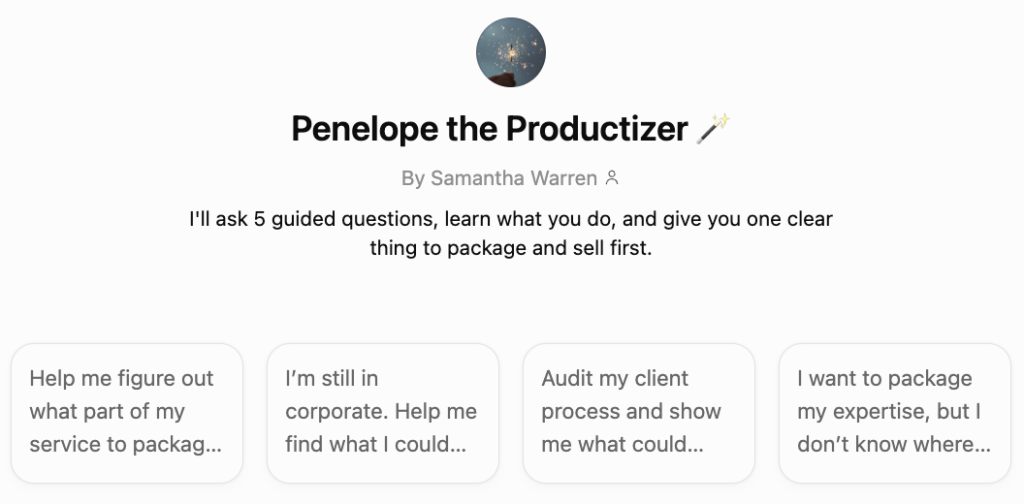
Before you read the full list, you can run that exact question through Penelope, the Productizer, my free AI-guided audit. She walks you through 5 sharp questions and gives you one named starting point you could package without trading more time for money.
Why digital products make sense for service providers
Before we get into the ideas, let’s be clear about what we’re actually doing here.
This is not about turning yourself into a content machine or pretending every offer can become “build once, sell forever.” That line sells because the creator economy is crowded and simple promises travel well. But the reality is less glamorous and far more useful: most digital products still require updates, marketing, support, and refinement over time.
What does change is this:
- You reduce customization
- You make your expertise more repeatable
- You stop negotiating your scope from scratch every time
- You create offers that rely on your standards, not your constant presence
That is a very different kind of freedom. More grounded. More honest. More sustainable.
And for a lot of service providers, digital products are not the final destination. They’re the bridge between founder-dependent income and a business with actual structure.
1. Audit Template
An audit template is one of the cleanest first digital products because it extracts how you evaluate something.
If you’re a marketer, designer, strategist, HR consultant, ops expert, or finance professional, you already have a mental checklist you run every time you assess a client’s situation. Put it on paper.
Best for:
- Marketing audits
- Brand audits
- Website audits
- SOP audits
- Hiring process audits
- Financial systems audits
The magic behind this idea:
You’re packaging your judgment criteria, not your hourly labor.
2. Swipe File or Example Library
A swipe file is a curated collection of examples with commentary, structured proof of what “good” looks like.
Best for:
- Copywriters
- Designers
- Sales consultants
- Recruiters
- L&D professionals
What to include:
- Real examples
- Why each one works
- Common mistakes
- A rubric for applying the example
This is especially strong if your clients struggle with discernment. You’re selling standards.
3. SOP Pack
If you have repeatable processes, you can turn them into a Standard Operating Procedure bundle.
Examples:
- Client onboarding SOPs
- Content workflow SOPs
- Team handoff SOPs
- Monthly close SOPs
- Project management SOPs
This is ideal for service providers with operational expertise because businesses pay well to reduce ambiguity.
4. Client Intake Kit
Most service providers ask the same questions over and over. A client intake kit turns that into a structured asset.
It might include:
- Intake form
- Pre-project questionnaire
- Discovery call prep doc
- Goal-setting worksheet
- Decision-making prompts
This works beautifully for consultants, coaches, designers, and strategists who want clients to arrive more prepared and less chaotic.
5. Strategy Workbook
A strategy workbook helps clients think better before they hire you or alongside your service.
Good use cases:
- Brand messaging workbook
- Offer clarity workbook
- Ideal client workbook
- Team planning workbook
- Quarterly strategy workbook
The point is not to replace your expertise. The point is to give people a contained way to access part of it.
6. Template Bundle
Templates are still useful when they solve a real operational problem.
Examples:
- Email sequence templates
- Proposal templates
- Reporting dashboard templates
- Training deck templates
- Manager feedback templates
Just remember: a template without context often underperforms. The strongest bundles include instructions, use cases, and examples.
7. Decision Tree or Flowchart
This is one of the most underused digital product formats for experts.
A decision tree helps people navigate common forks in the road using your logic.
Great for:
- Hiring decisions
- Marketing channel selection
- Offer selection
- Client qualification
- Workflow troubleshooting
This format is powerful because it separates founder value from founder labor. Your brain built the path. The buyer doesn’t need your calendar to use it.
8. Mini Training
A short training can be far more effective than a bloated course no one finishes.
Keep it focused:
- One problem
- One outcome
- One implementation window
Examples:
- How to write a better onboarding sequence
- How to build a reporting dashboard
- How to run a monthly review meeting
- How to prep your brand for a redesign
9. Workshop Replay + Toolkit
If you’ve already delivered live trainings, there’s a good chance you’re sitting on reusable IP.
Package the replay with:
- Slides
- Notes
- Workbook
- Action plan
- Templates
This is a smart move for service providers who don’t want to become full-time course creators but do want to leverage what they’ve already built.
10. Implementation Checklist
Do not underestimate the buying power of a good checklist. Businesses love anything that creates speed, confidence, and fewer dropped balls.
Examples:
- Launch checklist
- Onboarding checklist
- New manager checklist
- Quarterly planning checklist
- Rebrand checklist
A checklist works when it reduces emotional labor. Less “what am I forgetting?” More clean execution.
11. Diagnostic Quiz or Assessment
People pay attention when they feel accurately seen.
A diagnostic quiz or assessment can help buyers identify what stage they’re in, what’s broken, or what they actually need.
Examples:
- Brand readiness assessment
- Team operations scorecard
- Messaging clarity quiz
- Workflow bottleneck assessment
This can stand alone as a product or feed naturally into a higher-level offer.
12. Dashboard or Tracker
If your work involves measurement, create the system clients can use to monitor progress without needing you every five minutes.
Examples:
- KPI dashboard
- Content tracker
- Hiring pipeline tracker
- Budget tracker
- Monthly close tracker
This is where practical structure becomes a form of self-trust. People make better decisions when they can actually see what’s happening.
13. Boundary-Based Retainer Toolkit
This one is a little cheeky, but needed.
Many service providers don’t need more leads. They need cleaner containers.
A retainer toolkit could include:
- Scope document templates
- Communication boundaries
- Revision policy templates
- Client expectations guide
- Offboarding language
Scope creep is not always a logistics problem. Often it’s an identity leak. This product helps close it.
14. Productized Offer Blueprint
If you’ve already figured out how to standardize your own work, teach that process directly.
Include:
- Offer design framework
- Scope model
- Pricing structure
- Delivery timeline
- What can vary vs what cannot
This is especially useful for women leaving corporate or agency work who know they’re skilled, but are still packaging every project like it’s bespoke couture.
15. Done-With-You Toolkit
Not everyone needs full service. Some people need structure with support.
This format can include:
- Templates
- Video walkthroughs
- Office hours
- Submission review
- Guided implementation plan
It’s a strong bridge offer because it lowers delivery load without pushing clients into total DIY.
16. Prompt Pack or AI Workflow Kit
If you use AI inside your service delivery, you can package the workflows that support speed and consistency.
Examples:
- Content strategy prompts
- Brand voice prompt kit
- Client research prompts
- SOP drafting prompts
- Audit prompts
The key is not handing over a pile of prompts with no judgment attached. Include how to use them, when to use them, and how to evaluate output.
17. Resource Library
A resource library is useful when your clients need repeated access to tools, references, scripts, examples, and planning materials.
Could include:
- Templates
- Training clips
- Scripts
- Worksheets
- Checklists
- Rubrics
This can become a strong low-ticket or mid-ticket ecosystem offer, especially if your audience values organization and implementation.
18. Signature Method Guide
If your service has a repeatable philosophy or framework, turn it into a guide.
This is where a lot of founders start resisting, because codifying your method can feel like exposing the magic. But usually the opposite is true. Naming your method increases trust. It proves there is a structure behind the result.
Include:
- Your core framework
- The stages
- Common mistakes
- Decision points
- Standards for success
You do not become less valuable because your process is clearer.
19. Cohort-Based Digital Program
If you have teaching-heavy expertise, a cohort program can turn custom 1:1 delivery into structured group transformation.
Good for:
- L&D consultants
- Marketing strategists
- Leadership consultants
- Career professionals
- Operators
This works best when the outcome is specific and the curriculum is bounded. Group offers are not just “more people for less money.” They need design.
20. Hybrid Productized Service
This is the bridge I recommend most often.
A hybrid productized service combines digital assets with a defined amount of human support.
Example:
An ops consultant might sell:
- Workflow audit
- Prebuilt tracking dashboard
- SOP templates
- One implementation session
- One review round
A messaging strategist might sell:
- Messaging workbook
- Brand voice guide
- Prompt pack
- 90-minute strategy session
- Final review
This model is powerful because it preserves premium outcomes while reducing customization. For identity-attached experts, it’s often the most honest first move.
How to choose the right digital product idea
Not every idea is right for your business right now. Choose based on evidence.
Ask yourself:
- What do clients ask me for repeatedly?
- What part of my process already follows the same pattern?
- What can be standardized without lowering quality?
- Where am I over-involved out of habit, not necessity?
- What result relies on my judgment, but not always my hands?
That last one matters.
A lot of women are not under-earning because they lack expertise. They’re under-structured. They are still acting like their labor is the product, when the real product is often their method, their standards, their discernment, and their ability to shape a result.
Calm is a form of power in business too.
Frequently Asked Questions (FAQs)
What’s the difference between a digital product and a productized service?
A digital product is usually something the buyer can access directly, like a template, training, assessment, or toolkit. A productized service still includes labor, but that labor is standardized, scoped, and repeatable. Think fixed deliverables, cleaner timelines, and less founder chaos.
Do I need a big audience to sell digital products?
No, but you do need relevance and clarity. A smaller audience with a specific problem is often more useful than broad visibility. Distribution still matters. This is not about posting a Canva template and waiting for the universe to do admin.
What if my work feels too custom to package?
Most experts overestimate how much of their work is truly custom. Usually, the nuance lives in a few decision points, while the rest of the process is repeatable. That’s where bounded variability helps: standardize the core, define what can flex.
Should I create a course first?
Usually not. For service providers, a course is often a heavier lift than necessary. A template, audit, toolkit, or hybrid productized service is often a stronger first move because it stays closer to the work you already know gets results.
How do I know what part of my business can be turned into a product?
Look for:
- Repeated deliverables
- Repeated questions
- Repeated decisions
- Repeated client frustrations
- Work that depends on your framework more than your full-time presence
Stop treating your constant availability as proof of your value.
That is the deeper shift. Not just “make a digital product,” but separate your identity from your delivery method. Keep your standards. Keep your taste. Keep your judgment. But stop building a business that can only function at the speed of your personal output.
You do not need to disappear from your business to scale it. You need to get honest about what actually needs you, what only needs your method, and where you’ve confused over-involvement with quality.
If that’s the work in front of you, start with Penelope, the Productizer. She’ll walk you through 5 questions and help you identify the one thing in your business that could be packaged into a real offer… more than just a vague idea. A shaped starting point you can actually build from.
Pin me to your favorite Pinterest board!