There’s a very specific kind of guilt that shows up the moment you stop performing “easy.”
You say no. You set the boundary. You choose the option that’s best for your life… and suddenly you’re cast as selfish, cold, dramatic, or “changed.”
If you’re a hyper-independent woman, that guilt can be even louder. Not because you’re actually self-centered, but because you’ve probably spent years being the capable one. The safe one. The one who can “handle it.”
I know this pattern intimately because I was raised inside it.
I was a textbook people-pleaser. Straight A’s. Gold star energy. The kid who wanted teachers, parents, friends (everyone!) to feel proud of me.
I learned early that being “easy” bought safety. Approval. Belonging.
And it worked… externally.
Internally? I was constantly disappointing myself. I’d feel that quiet resentment build every time I chose what was expected instead of what was true.
No one warned me that you can be highly successful at pleasing others and still feel deeply misaligned with your own life.
I’m Sam. I’ve been self-employed for about five years, I’m a full-time digital nomad, and I build calm, scalable systems for a living. But the real work wasn’t learning how to work from anywhere. It was learning how to live from within myself… without constantly asking for reassurance, permission, or external approval. Freedom (real freedom) is the result of trusting yourself enough to choose intentionally… even when it disappoints people.
Let’s talk about why choosing yourself feels selfish, how to tell the difference between healthy self-interest and actual selfishness, and how to do it ethically, without spiraling, over-explaining, or burning your whole life down.
The real reason “choosing yourself” feels like betrayal
When I started my business almost five years ago, I didn’t have a cheering section.
I wasn’t doing something people around me understood. A marketing consultancy? Fully online? No office? No “real” boss?
A lot of the lack of support wasn’t malice… it was fear. People project their own fear onto decisions they don’t recognize as safe.
Choosing myself in that season looked selfish. I wasn’t following the script. I wasn’t prioritizing comfort or predictability.
But here’s what actually happened: I built a calm, scalable business. I learned how to regulate myself. I created stability that didn’t depend on external approval.
What looked selfish from the outside was actually self-led. And it allowed me to show up more generously, not less.
Here’s the truth: for a lot of women, guilt isn’t a moral verdict… it’s a social alarm.
It goes off when you:
- disrupt your usual role (helper, peacemaker, fixer, “low maintenance” girlfriend, reliable daughter)
- risk disappointing someone
- stop overfunctioning so other people can underfunction
You don’t feel guilty because you’re wrong. You feel guilty because you’re changing the rules.
And if you grew up learning that being agreeable was safer than being honest, your nervous system might interpret “no” as danger, even when your adult mind knows it’s normal.
Guilt can mean:
- “I’m doing something new.”
- “I’m disappointing someone who benefited from my self-abandonment.”
- “This choice changes how people can access me.”
Not cute. Just accurate.
Selfishness vs. self-interest vs. self-compassion
A lot of internet advice throws every “choose yourself” concept into one bucket. We’re not doing that here.
Self-interest (neutral)
Acting to meet your needs or goals.
Self-interest isn’t good or bad. It depends on how you do it and who pays the cost.
Healthy selfishness (ethical self-interest)
This is the sweet spot most people mean when they say “choose yourself.”
It looks like:
- prioritizing rest so you can function
- setting boundaries so you stop resenting everyone
- saying no to emotional labor you didn’t consent to
- choosing aligned decisions over being liked
Healthy selfishness is basically: I matter, and you matter too.
Unhealthy selfishness (exploitative self-interest)
This is where the word “selfish” actually fits.
It looks like:
- manipulating people to get what you want
- consistently disregarding others’ needs and consent
- breaking agreements without repair
- using “self-care” as a shield for cruelty
Self-compassion (not self-indulgence)
Self-compassion is treating yourself with kindness, common humanity, and mindfulness, especially when you mess up.
If you’ve been running on self-criticism as your main “motivation,” self-compassion can feel like you’re letting yourself off the hook. You’re not. You’re just finally choosing a strategy that works long-term.
The selfish–selfless spectrum (and why overgiving is not automatically “good”)
Most people think the options are:
- be selfish
or - be selfless
Real life is a spectrum.
Research on the neurobiology of selfish vs. selfless behavior discusses extremes on both ends, where either callous self-focus or harmful overgiving can create problems.
Here’s the spectrum I want you to visualize:
- Callous / self-serving extreme: low empathy, extraction, “my needs always win”
- Balanced ethical self-interest: boundaries, reciprocity, sustainability
- Pathological altruism extreme: overgiving that harms you and often enables others
That last one matters for my people. Because a lot of hyper-independent women aren’t “too selfish.” We’re more likely to be trained into:
- over-responsibility
- emotional overfunctioning
- loyalty that turns into self-abandonment
And then we call it “being strong.”
Sometimes “choosing yourself” isn’t a swing toward selfishness.
It’s a correction back to center.
Why people react so strongly when you set boundaries (it’s not always about you)
Let’s make this less personal in the best way.
People aren’t just reacting to your boundary. They’re reacting to what your boundary implies:
- that access to you is optional, not guaranteed
- that their comfort isn’t your job
- that the dynamic may need to update
There’s also a projection component. Research out of the University of Illinois suggests people often expect others to mirror their own generosity or selfishness. In other words: how someone behaves shapes what they assume is “normal.”
So if someone is used to:
- overextending
- never saying no
- martyring themselves and calling it love
…your boundary will look “selfish” to them because it violates their internal norm.
Sometimes the backlash isn’t about morality.
It’s about mismatch.
When choosing yourself actually is selfish (and what to do instead)
This is the part most “choose yourself” content skips because it’s less sexy. But it’s what gives you integrity.
Choosing yourself veers into unhealthy selfishness when it:
- Externalizes costs onto someone who didn’t consent (dumping responsibilities with no plan)
- Violates agreements (contracts, commitments, shared responsibilities) without repair
- Uses “protecting my peace” to avoid accountability
- Becomes a pattern of one-way extraction: taking support, refusing reciprocity
There’s a Psychology Today framing that selfishness can aid survival, but in a society, it needs limits. In plain language: self-interest is normal; harm isn’t.
The ethical upgrade: communicate, mitigate, repair
If your choice impacts others, you’re not “bad.” You’re responsible.
That can look like:
- giving notice instead of vanishing
- proposing a transition plan
- acknowledging the impact without surrendering your boundary
- making amends where you genuinely broke an agreement
This is how you become self-led without becoming careless.
Choosing yourself as a manifestation practice (the grounded version)
I believe in manifestation. I don’t believe in delusion.
Manifestation is not “I want it, therefore it’s mine.”
It’s self-trust + aligned decisions + grounded action over time.
And here’s the part people don’t want to hear:
You cannot manifest a life you do not trust yourself to hold.
Because if you don’t trust your decision-making, every desire turns into anxiety:
- “What if I choose wrong?”
- “What if I disappoint people?”
- “What if I can’t maintain it?”
That’s a big manifestation mistake.
The same thing happened when I left a relationship I was unhappy in.
On paper, I had reasons to stay. History. Comfort. The version of me everyone was used to.
Leaving looked dramatic. Self-focused. Like I was “throwing everything away.”
What I actually chose was alignment. I started traveling. I became a digital nomad. I learned how to be with myself without outsourcing my certainty to a relationship.
And here’s the part people miss: when you live in alignment, you don’t become less generous. You become more grounded.
You do better work. You’re clearer in your boundaries. You stop leaking resentment.
Alignment isn’t selfish… it’s actually stabilizing.
Myth-busting: the thoughts that keep you trapped
Myth: “If I feel guilty, I’m doing something wrong.”
Truth: Guilt is often conditioned. It’s a social alarm, not a moral compass.
Myth: “Self-compassion is self-indulgence.”
Truth: Self-compassion is linked with responsibility and accountability, not excuse-making.
Myth: “Good people always say yes.”
Truth: Chronic yeses become resentment, burnout, and passive harm.
Myth: “If they loved me, they’d understand immediately.”
Truth: When you change patterns, people test the old rules. That’s not proof you’re wrong. It’s proof the system is recalibrating.
Practical examples of choosing yourself (without making it a personality)
If you need proof that this is normal life stuff, not a dramatic reinvention, here are a few grounded examples:
- Family: You don’t travel for every holiday because it wrecks your finances and health. You offer a video call and plan a later visit.
- Work: You stop doing unpaid labor and set clear scope boundaries. Your business becomes calmer and more profitable.
- Friendships: You step back from groups built on gossip or crisis cycles. You choose solitude during a level-up season.
- Dating: You end something misaligned instead of “waiting it out” and calling it loyalty.
- Health: You prioritize sleep, therapy, movement, medical care—even if someone labels it “dramatic.”
Choosing yourself isn’t reckless. It’s regulated.
I’ll Leave You With This…
Choosing yourself feels selfish when you’ve been trained to earn belonging by being easy.
But most of the time, what you’re actually doing is unlearning self-abandonment.
Self-led women aren’t reckless. They’re regulated.
They don’t disappear. Instead, they decide.
And if you want a grounded way to make those decisions without spiraling, over-explaining, or crowd-sourcing your life to everyone else, I built a tool for that.
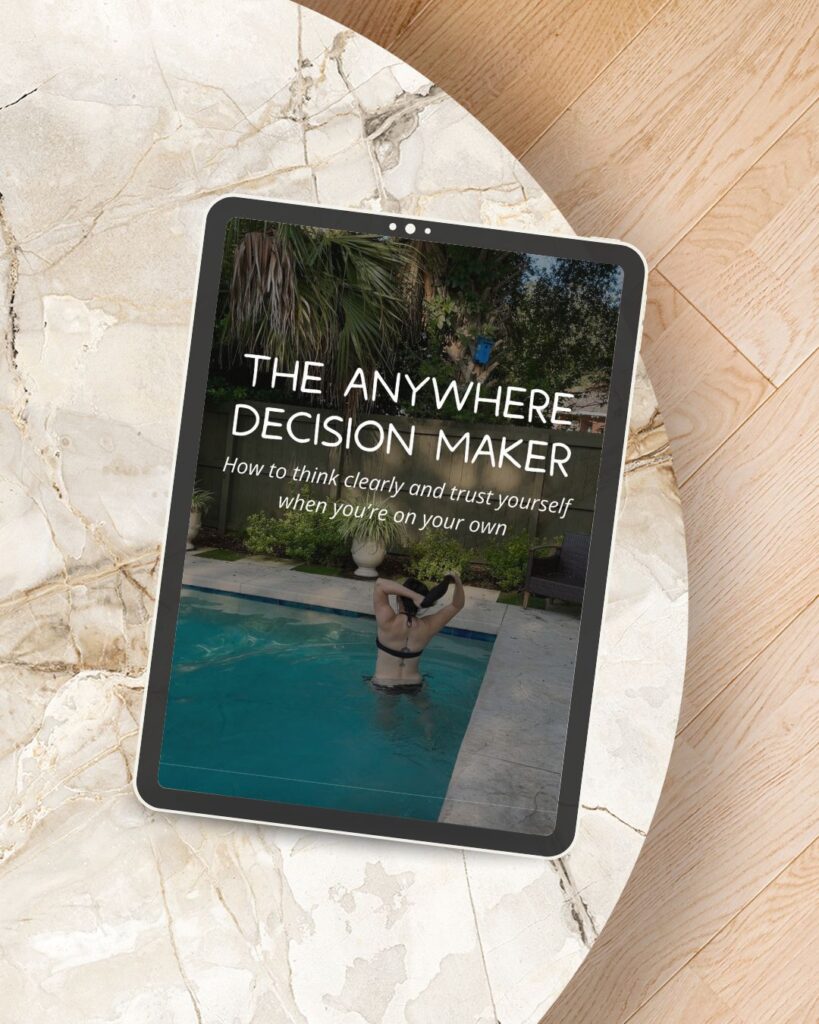
The Anywhere Decision Maker helps you slow down, choose intentionally, and trust yourself, even when guilt shows up loud.
Not because you’re becoming selfish.
But because you’re becoming solid.
Enter your name and email below to get access to this free tool.
Pin Me on Pinterest!