There comes a point in a service business where the issue is no longer whether you’re good at what you do. The issue is that your expertise is trapped inside your personal involvement.
That’s the part nobody glamorizes. You can be fully booked, highly capable, and still quietly building yourself another version of a job. Just with better branding, more tabs open, and a stronger coffee order… but the business isn’t growing.
I know this because I’ve lived the arc myself. Before Paid to Be Her, I scaled a marketing agency to 20+ clients by saying yes too often and keeping too much dependent on me. It worked, until it didn’t. My pivot started with one question: what part of what I already do doesn’t actually need me? That question changed everything, and it’s the same one I want you asking as you read this.
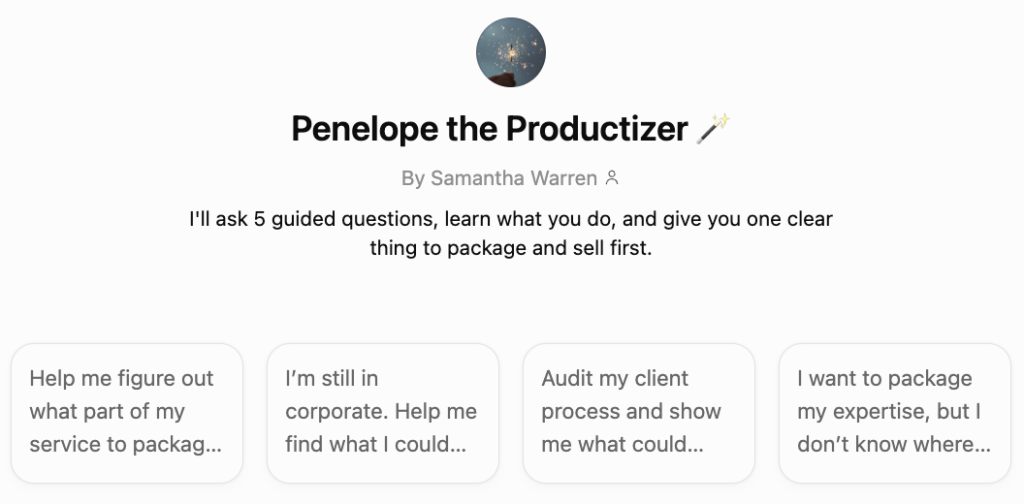
If that question is already hitting something for you, start with Penelope, the Productizer. It’s a free AI-guided audit that walks you through five real questions and gives you one concrete thing you could package without adding more hours.
Why digital products feel confusing for smart service providers
A lot of women need clearer discernment and more intuitive feedback… not more ideas. Ideas are not usually the problem.
The internet has made “digital product” sound like one thing, when it’s actually a category with very different business models inside it. A template shop is not the same as an audit. A workshop is not the same as a toolkit. A mini-course is not the same as a licensed method.
And this matters because the wrong format creates more work, not more freedom.
Productization changes your scope, delivery variance, and pre-sale labor. It does not magically remove effort. Evergreen is an operating model, not a guarantee. You still need positioning, traffic, maintenance, support, and standards. Calm businesses are built through structure, not fantasy.
It also helps to understand why this feels so personal. Experts often struggle to package what they do because of what researchers call an expert blind spot or the curse of knowledge. Once you know something deeply, you forget which steps are invisible to other people. Add identity attachment on top of that — “it only works because it’s me” — and suddenly documentation feels like loss instead of leverage.
How to pick the right digital product format
Before you choose a format, run it through three filters:
What result do people already trust you for?
Not what you could teach in theory. What do people repeatedly come to you for?What part of that result can be standardized?
Inputs, process, templates, diagnostic steps, decision rules, examples.How much of your judgment is truly required?
Some steps need you involved, but all the other steps can be reformatted and productized to free up your time and energy.
If your digital product still depends on custom thinking at every stage, you haven’t really packaged it. You’ve just renamed the product and put a pretty little bow on it.
Now let’s break down the 12 formats… but first, since you made it this far, have a treat:

1. Audit
An audit is one of the best first digital product formats for service providers because it turns your discernment into a fixed offer.
Think:
- brand audit
- funnel audit
- finance audit
- operations audit
- people systems audit
The value is diagnosis. Clients are paying for clarity, not endless access.
Best for: strategists, consultants, operators, marketers, finance and systems people
Works well when: you can evaluate the same set of inputs each time
Watch out for: turning a fixed audit into free consulting
Good fit if:
- you’re excellent at spotting what’s wrong quickly
- clients often ask, “can you just look at this?”
- your first hour with a client tends to be the most valuable part
2. Roadmap or Action Plan
This is closely related to an audit, but the deliverable is the plan itself.
You review the situation, then hand over a sequenced path forward:
- what to do first
- what to ignore for now
- where the bottlenecks are
- what decisions need to be made
This is ideal for women with strong corporate experience because so much internal expertise is really prioritization under uncertainty. That is sellable.
Best for: project managers, operators, consultants, growth strategists
Works well when: clients are overwhelmed and need direction more than implementation
Watch out for: making the roadmap too broad to act on
3. Template Pack
Template packs are useful when your audience needs speed, structure, and a starting point.
Examples:
- proposal templates
- email sequences
- onboarding templates
- pricing calculators
- SOP packs
- manager feedback scripts
Templates work because they reduce decision fatigue. They give someone a contained way to move.
Best for: service providers with repeatable documents or workflows
Works well when: you already reuse similar assets behind the scenes
Watch out for: selling files without enough context to create results
A template is strongest when it includes light guidance on when, why, and how to use it.
4. Toolkit or Resource Library
A toolkit is broader than a template pack. It usually combines multiple assets around one outcome.
For example:
- checklists
- swipe files
- scripts
- examples
- calculators
- SOPs
- implementation notes
This works well when your method requires more than one asset but not a full training program.
Best for: experienced service providers with a clear process
Works well when: clients need both tools and light decision support
Watch out for: creating a messy vault full of files nobody uses
The more freedom you give inside a product, the more structure you need around it. That’s true in business and in life, honestly.
5. Workshop
A workshop is a contained teaching experience built around one result.
Not “everything I know about marketing.”
More like:
- clarify your offer in 90 minutes
- set up your client onboarding system
- build your pricing model
- map your content pillars
Best for: educators, strategists, and people who teach through frameworks
Works well when: your audience needs momentum and live structure
Watch out for: over-teaching and under-scoping
6. Mini-Course
A mini-course is useful when the transformation needs sequential learning, but not a massive curriculum.
This is a strong format when your clients need to understand a process in order:
- assess
- decide
- implement
- refine
Best for: service providers with a teachable method
Works well when: the same concepts need to be explained repeatedly
Watch out for: building a course when people actually just need a tool or decision
A lot of smart women hide inside course creation because it feels productive and polished. Be careful there. If your client only needs one clear answer, don’t give her eight modules and a welcome video.
7. Implementation Sprint
This is one of the strongest productized formats because it keeps the transformation tangible while containing your labor.
Examples:
- messaging sprint
- Notion setup sprint
- launch systems sprint
- execution OS sprint
- pricing cleanup sprint
Fixed timeline. Fixed scope. Fixed deliverables.
Best for: done-for-you or done-with-you service providers
Works well when: you can reliably deliver one outcome in a short window
Watch out for: hidden customization and revision creep
This format is where boundaries become business infrastructure.
8. Subscription Membership
A membership gives clients ongoing access to resources, support, updates, or implementation spaces.
This can look like:
- monthly templates
- office hours
- resource drops
- guided implementation support
- a bounded request menu
Best for: people with ongoing audience needs and repeat support questions
Works well when: there is a recurring problem, not just a one-time fix
Watch out for: building yourself a low-ticket emotional labor pit
If you go this route, define:
- what members get
- what they do not get
- where support happens
- how often things are updated
Support creep is real. Don’t call it community when it’s actually unpaid customer service.
9. Assessment or Scorecard
This format packages your judgment into a structured diagnostic.
Examples:
- business readiness scorecard
- pricing maturity assessment
- management capability scorecard
- operations bottleneck checker
This can be delivered as a PDF, Typeform, quiz, or guided tool.
Best for: consultants, strategists, educators, analysts
Works well when: clients need awareness before they’re ready to buy deeper support
Watch out for: making it too vague to produce insight
Assessments are effective because they meet people at the self-awareness stage. They also create a natural bridge into a roadmap, audit, or sprint.
10. Calculator or Decision Tool
Some expertise is best packaged as a decision engine.
Think:
- pricing calculators
- capacity planners
- profit forecasting sheets
- content planning matrices
- client-fit decision tools
This is especially strong for finance, operations, and strategy-based brands because it turns private logic into visible structure.
Best for: analytical service providers
Works well when: your value comes from helping people make cleaner decisions
Watch out for: assuming the spreadsheet explains itself
A tool is only as good as the thinking embedded inside it.
11. Licensed Method or Training-in-a-Box
This format takes your framework and makes it teachable or usable by others.
It might include:
- facilitator guide
- slide deck
- workbook
- exercises
- recorded training
- delivery instructions
Best for: consultants, educators, trainers, internal experts leaving corporate
Works well when: your framework can be repeated by teams, managers, or facilitators
Watch out for: trying to license something you haven’t tested enough
This is one of the most powerful formats for women with deep internal expertise from corporate. So many of you have spent years building systems inside other people’s companies without realizing those systems are owned assets waiting to be extracted.
12. Hybrid Productized Service
This is often the smartest option.
A hybrid productized service combines digital assets with a limited human component. For example:
- audit + 60-minute debrief
- toolkit + implementation review
- mini-course + office hours
- sprint + templated handoff system
This format works because it separates where your judgment is essential from where it isn’t.
Best for: service providers transitioning out of bespoke work
Works well when: clients still want some access to you, but not full custom support
Watch out for: adding “just one more touchpoint” until the model collapses
If you’re in a season of identity shift, this is often the cleanest bridge. You do not have to jump from one-on-one work straight into fully detached digital products. You can build trust with yourself in layers.
How to know which format is right for you
If you’re stuck between options, use this shortcut:
Choose an audit or roadmap if:
- your genius is diagnosis
- clients need clarity first
- you want the easiest first step into productization
Choose a template pack, toolkit, or calculator if:
- you already use repeatable assets
- your method includes documents or decision rules
- your audience is DIY-capable
Choose a workshop or mini-course if:
- your process needs explanation
- clients benefit from guided learning
- you naturally teach in frameworks
Choose a sprint or hybrid productized service if:
- clients want outcomes, not information
- you’re moving out of custom services
- you need stronger boundaries around delivery
Choose a membership or licensed method if:
- the need is ongoing or repeatable across groups
- you already have a tested body of work
- your audience wants continuity, not just a one-off fix
Common mistakes when choosing a digital product format
Before you build anything, avoid these business mistakes:
Packaging the wrong layer of your expertise
People don’t buy your hours. They buy resolution.Creating a product before defining the container
Scope, support, revision policies, and qualification matter.Confusing custom care with quality
More personalization is not always more value.Ignoring capacity math
If delivery still expands every time, your offer is not contained.Building from fear instead of standards
“I need multiple offers” is usually panic in a blazer.
Frequently Asked Questions (FAQs)
What’s the best first digital product for a service provider?
Usually an audit, roadmap, or hybrid offer. They’re easier to create because they start from work you already know how to do, and they let you package your thinking without pretending your clients need a giant course.
What’s the difference between a digital product and a productized service?
A digital product is typically an asset someone can buy and use, like a template, toolkit, workshop, or course. A productized service includes service delivery, but with fixed scope, pricing, and process. A hybrid model sits in the middle and is often the most practical starting point.
How do I know if my expertise can be productized?
Look at your last 10 wins and ask:
- what problem kept repeating?
- what process did I repeat?
- what assets did I reuse?
- where was my judgment actually necessary?
If some of the outcome can be delivered through structure, it can likely be productized.
Should I create a course or a template first?
Create the smallest format that delivers the result. If your audience needs a tool, don’t build a course. If they need explanation and sequence, a mini-course or workshop may make more sense.
Can digital products replace one-on-one services completely?
Sometimes, but that shouldn’t be the first goal. A more grounded goal is to reduce delivery variance, protect your energy, and stop tying all revenue to your calendar. You’re building options, not chasing a fantasy.
Final Thoughts
The right digital product format is the one that matches your actual expertise, your audience’s real need, and the level of involvement you want your business to require from you.
That’s the deeper shift… not just from services to products, but from proving your value through constant presence to expressing your value through structure.
Freedom in business is not about doing less carelessly. It’s about building a model that can hold more without requiring you to abandon yourself inside it. Calm is a form of power. So is a business that no longer needs you in every corner to keep working.
If you’re ready to stop guessing and identify the one part of your work that can be cleanly packaged, try Penelope, the Productizer. She’ll walk you through five questions and give you one named starting point, rooted in what already works, not in what you think you should create.
Pin Me on Pinterest!