I’m a self-proclaimed control freak and an anxious girly (I’m a Capricorn sun, okay?), so whenever someone tells me to just trust the timing of my manifestation, every cell in my body wants to argue. I understand what it’s like to be told over and over to trust something you can’t see yet. I f*cking hate it, because it goes against every instinct I have to control things and move them forward.
So if you’re checking Stripe four times a day, picking up your phone every few minutes to see if he texted back, or asking the universe “when?” every single night, I see you, and I’ve been you. What I’ve learned is that you can want something with your whole heart and still be detached from it. And manifesting from that place is so much more fun than thinking about the thing every waking second of the day.
In this post I’m walking you through what detachment actually means, the research on why gripping backfires, what to do with your mind while you wait, and the ChatGPT prompt I use whenever I catch myself holding on too tight.
If you’d rather watch than read, the full video is right here:
What detachment in manifestation actually means
A lot of manifestation mentors say “just let go,” and most of us hear that as “pretend you don’t care” and act aloof. That’s where people take it too far, because pretending is a lie. If you’re trying to manifest something, you care a lot. You want the clients, your dream relationship, the apartment that actually feels cozy to live in and the money in your account. Pretending you don’t want those things feels fake, and that fakeness can block your manifestation all by itself.
So here’s how I think about it. There’s a difference between wanting something and needing it.
Wanting is an excited, open feeling, and it’s magnetic. It sounds like “I love this, so I’m going to go for it,” and the process itself lights you up. That’s how I feel filming YouTube videos for you right now: it’s fun and it feels expansive.
Needing is a tight, scared feeling. It sounds like “if I don’t get this, I’m not going to be okay.” Wanting comes from abundance and feels expansive, while needing comes from scarcity and feels constrictive. And the needing is built on a lie too, because you’re going to be okay no matter what happens.
This idea is actually really old. In Buddhism it’s called non-attachment: you hold the thing you want with an open hand, without clinging to it or pushing it away. That’s what detachment means to me. You keep the wanting, you loosen the grip, and you let the universe take the wheel on timing (the timeline was always the universe’s to decide anyway). And if it isn’t the exact thing you’re manifesting, trust that it’ll be something even better.
What Needing Looks Like on a First Date
Think about a first date you were genuinely excited for. You went in curious, asked questions, flirted and were open to actually meeting the person. Now think about a date where you needed it to go well. You watched every little sign and read into every little thing he said.
I had this exact experience. I was out with a guy I really liked, and he made an aside about usually dating Colombian women (I’m not a Colombian woman, okay?). I got so anxious that I almost felt rejected in that moment. Looking back, it wasn’t really a rude thing to say. Maybe it wasn’t the best thing to bring up on a date, and I still blew it way out of proportion, because I was so focused on making the date go well and making him like me. That was all coming from scarcity. If I’d gone in with more of an abundance mindset, that comment would have rolled right off me, because all you can control is your response to things, and other people get to act however they act.
So the thing we’re working on here is the needing: the clingy, almost pick-me energy that says “I’m not okay until this shows up, until he likes me, until I land this client.”
Why “just stop thinking about it” backfires (the white bear study)
The first thing most of us try is to stop thinking about it. You tell yourself, “Okay, I’m detaching, so I’m not going to think about money anymore,” and then, ironically, it’s all you think about.
There’s a classic study from the 1980s that explains why (Wegner et al., 1987). Researchers told people not to think about a white bear for five minutes straight, and because they were so focused on not thinking about the bear, they couldn’t do it. Then, when they were allowed to think about the bear again, they thought about it even more than the people who’d been allowed to think about it the whole time.
Here’s the part I love the most. In a second experiment, people were given one specific other thing to think about instead, and those people had a lot less of that bounce-back effect.
You know when a client hasn’t paid an invoice and you really need the money? You keep telling yourself to forget about it, and then you’re thinking about it in the shower, at 2 AM and on the walk you took to escape the thought. That’s the white bear, my friends.
So detachment means giving your mind something better to think about. Forcing the thought out only makes it come back louder. When it shows up, you’re allowed to say, “Yes, I still want that. I want to date this person, I want this amount of money, I want this specific client.” Then you let the thought pass and point your attention at something else, instead of hyper-fixating on it.

If you’re reading this and realizing your mind has been stuck on one white bear for weeks, my free Manifest with ChatGPT workbook has a behavior stack built for turning that wish into small next steps you can take today.
Why constant checking keeps you stuck
In the case of money, the thing keeping you stuck is often the checking: checking Stripe, checking your bank account, checking the sales page, looking at your analytics again and again. Checking feels good for about two seconds, and then the worry comes back, so you check again. It turns into an almost addictive loop that’s really hard to get out of, because the checking is coming from the worry.
There’s an interesting study on this (Kushlev & Dunn, 2015). Researchers asked more than 100 adults to check their email only three times a day for one week, and as often as they wanted for another week. During the three-times-a-day week, people felt less stressed.
Give Yourself a Checking Window
So here’s what you can take from that. Give yourself a checking window. Pick one time a day to look at your numbers (or however many times a week feels right), instead of letting yourself check whenever the anxiety hits.
You’re still paying attention to your goal, and you’re doing it on purpose, at a time you chose. That creates space in your mind for the other things that are just as important. Constant checking is a result of anxiety, and a limited checking window is a calmer, more disciplined way to practice detachment.
How scarcity gives you tunnel vision
When you feel like you don’t have enough (enough love, enough money, enough clients, whatever it is for you), your brain gets tunnel vision. You stare so hard at the thing you’re scared of losing that you lose sight of all the other amazing things around you.
I’ve lived through this so many times. When I was running my marketing agency, I said yes to every client and every opportunity, because I was scared of losing the money and the revenue. I felt like I kept having to prove something, so the business consumed every area of my life, and every waking moment was dedicated to that company. I burned friendships and romantic relationships because of that tunnel vision, and looking back, I was operating from scarcity the whole time.
When you loosen your grip and can see the amazing things around you again, you get bandwidth back for the rest of your life: your friendships, your relationships and the other things that matter to you. I know this is hard (self-proclaimed control freak, remember?), and it’s worth it.
What to do while you wait for your manifestation: flow and awe
So if you’re not going to force the thought out and you’re not going to check constantly, what are you supposed to do now? I’ve got two things for you, plus a ChatGPT prompt below.
1) Flow
Flow means giving your brain something challenging, challenging enough to pull your attention away from the thing you’re obsessed with while still feeling good. A study at UC Riverside looked at this (Sweeny, UC Riverside). Students who were waiting on stressful news played Tetris, and because the game kept their brains busy with something challenging, they felt more positive and less negative about the wait. It’s a small effect, and it’s totally real.
So you could take a Pilates class, learn a new skill or sign up for a cooking class. Pick something that gets your mind off the thing you’re gripping. (And before you ask, scrolling TikTok doesn’t count. I’m sorry.)
2) Awe
Awe is the feeling you get staring up at the stars, watching a beautiful sunset or reaching the top of a mountain with a gorgeous view. It’s so big that it makes all of your worries feel small, because you remember how big and beautiful the world and the universe are.
I live in Panama and I love going on hikes. There’s a hill I like to hike all the time, and when I get to the top, I realize how tiny my stresses and worries are compared to everything else going on around me and the workings of the universe.
This is where detachment and action come together. Your wanting gives you a direction, flow and awe give your mind something to focus on besides your manifestation, and trusting the universe lets you stop being a control freak so your timeline can deliver when it’s time.
The ChatGPT prompt for when you’re gripping too tightly
I use this prompt whenever I notice myself checking, bargaining or obsessing over a manifestation. Copy and paste it into ChatGPT, Claude or your AI tool of choice, and fill in the part in brackets.
I’m manifesting [what you want]. I want to keep wanting it with my whole heart and stop gripping it so tightly.
Ask me these questions one at a time and wait for my answer before you ask the next one:
1) What do you want in one specific sentence?
2) When you imagine it not happening yet, what are you afraid that would mean about you?
3) What do you check, refresh, or look for signs about when you feel anxious about it?
4) What’s the one thing most likely to get in your way?
After I answer all four, give me: a one-sentence wanting statement I can say without feeling desperate, an if-then plan for the moment I usually start gripping, one small action I can take this week, and a checking window: when and how often I’ll check on it.
Why This Prompt Works
Question two goes straight to the needing, because the panic you feel is usually about what it would mean if you don’t get the thing. Question three puts your checking habit in check. Question four finds the thing most likely to trip you up, so you’re aware of it and can plan for it ahead of time.
Then ChatGPT turns all of that beautiful detail into a plan for you, so your mind has something better to do than worry about the white bear.
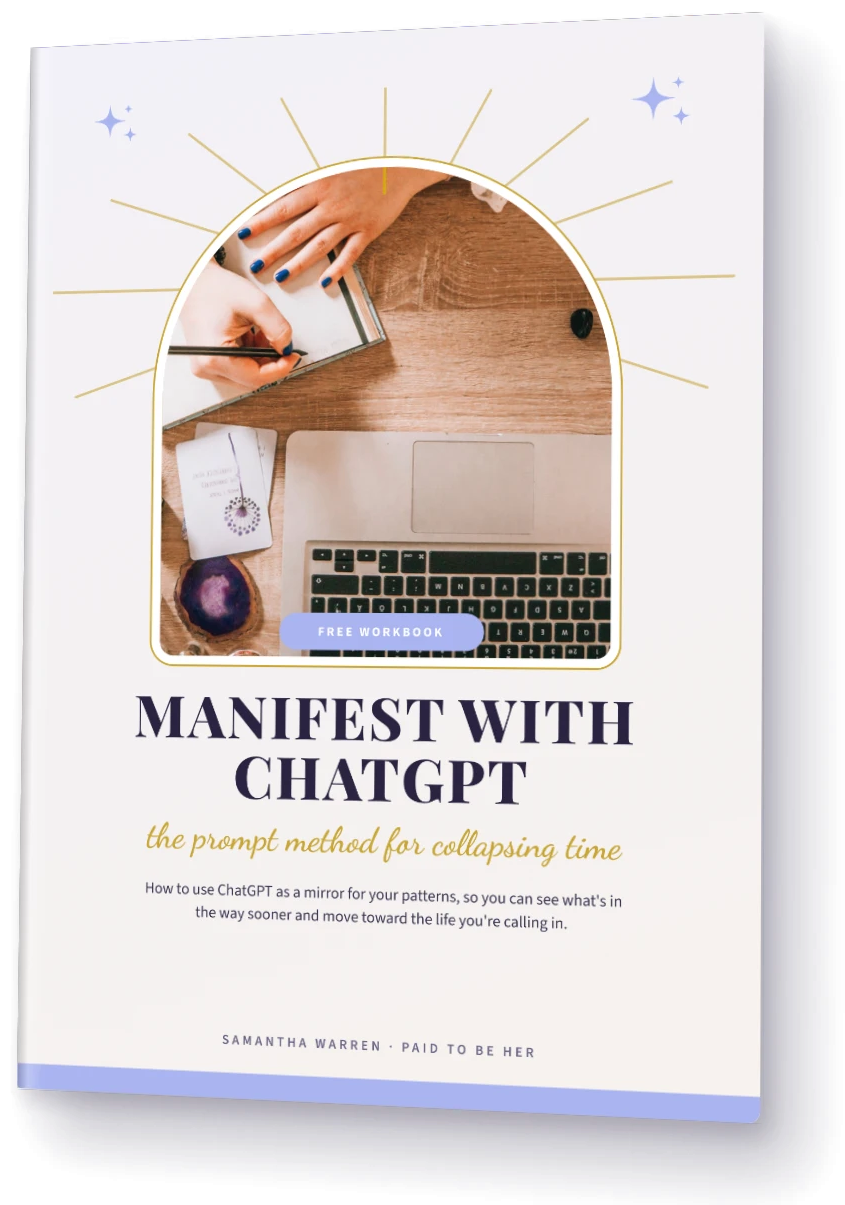
Get the free Manifest with ChatGPT workbook
If this prompt helped you breathe a little easier, you’re going to love my free workbook, Manifest with ChatGPT. It’s my framework for collapsing time in your manifestations, and it picks up right where this post leaves off. The behavior stack inside is especially good for detachment, because it turns your wish into small next steps you can take action on today, which gives your mind a much better job than checking.
Here’s what’s inside:
- The setup prompt that tells ChatGPT who you are and what you’re calling in, so it stops handing you generic answers.
- My 5-part prompt formula, so you can write your own prompts (like a custom version of the detachment prompt above) that sound like you.
- 6 prompt stacks for desire, belief, evidence, identity leaks, behavior and feedback. The belief stack is great for the “what would it mean about me” fear from question two.
- A follow-up toolkit for when ChatGPT’s first answer isn’t quite it.
- Notes pages so your wanting statement, if-then plans and checking window live in one place.
It’s free. Pop your email in below and it’s yours.
FAQ
1) What does detachment mean in manifestation?
Detachment means you keep wanting the thing and loosen your grip on it. You let go of needing it to show up on your timeline and in your exact way, and you stop treating your okay-ness as dependent on it. In Buddhism this is called non-attachment: holding what you want with an open hand.
2) Do I have to stop wanting something to detach from it?
No, you get to keep the wanting. Wanting is the excited, open feeling that gives you direction and makes the process fun. The part to work on is the needing, the tight, scared “I’m not okay until this shows up” feeling that comes from scarcity.
3) Why do I think about my manifestation more when I try not to?
That’s the white bear effect. In a classic 1980s study, people told not to think about a white bear couldn’t stop thinking about it, and later thought about it even more. People given one specific other thing to think about had much less of that bounce-back, so give your mind something better to focus on instead of forcing the thought out.
4) How do I stop obsessively checking for signs my manifestation is coming?
Set a checking window: one time a day (or a few times a week) when you look at your numbers, inbox or sales. In one study, adults who checked email only three times a day for a week felt less stressed than when they checked as often as they wanted.
5) What should I do while I wait for my manifestation?
Give your mind flow and awe. Flow comes from something challenging that holds your attention, like a Pilates class, a new skill or a cooking class (scrolling doesn’t count). Awe comes from things like a sunset, the stars or the view from the top of a hike, which make your worries feel small again.
Here’s what I want you to take away…
Keep the wanting and keep the desire deep down in your soul, and loosen the grip. Let your hair down, enjoy the process, make your checking purposeful and keep your thoughts about your manifestation intentional.
There’s nothing wrong with asking the universe for what you want, and there’s nothing wrong with praying for it. You should do both. There’s a time and a place for it, though, and it doesn’t need to live rent-free in your head 24/7. And ironically, once you stop obsessing, you’re more likely to take intentional action toward your manifestation, and you’ll have time and space for all the other beautiful things in your life. That’s how you become the woman who wants it with her whole heart and trusts it’s on its way.
Tell me what you’re loosening your grip on
I’d love to know what you’re manifesting right now and what you’ve been gripping a little too tightly. DM me on Instagram at @SamanthaLeeWarren and tell me, because I’d love to support you on your journey. 💙
And if you want to turn that desire into your next small steps tonight, grab my free Manifest with ChatGPT workbook.
Pin me to your favorite Pinterest board!